+1 (917) 565-8527

 info@indeedseo.com


SEO Strategies for Healthcare Providers in Australia require a precise balance of digital visibility and regulatory compliance. Attracting new patients online isn’t just about ranking at the top of Google; it is about navigating strict AHPRA advertising guidelines while satisfying Google’s rigorous “Your Money or Your Life” (YMYL) content standards.
This guide breaks down the essential, compliant SEO strategies Australian healthcare practices must implement to drive more patient bookings and build lasting digital trust.

SEO Tips for Healthcare Providers in Australia
SEO Tip #1: Get as many links to your website from other websites as you can
Links from good sites are a “vote of confidence” for your content. The more quality links you get, the more likely your site will appear higher in search results. Target links from appropriate niche sites. Quality links from good sites will add to your authority and bring organic traffic.
SEO Tip #2: Avoid links from dodgy, spammy websites
Spam or low-quality links can blacklist your site and make your ranking go downhill. Avoid link farms, paid links, and irrelevant sites that look spammy. Algorithms in Google do detect poor link profiles in websites. Keep the links natural and relevant to not harm your SEO ranking.
SEO Tip #3: Identify your ‘keywords’
Keywords are words or phrases that people use to search for information pertaining to your site. Utilize tools such as Google Keyword Planner to identify popular, relevant keywords. Relevance of keywords will draw users directly searching for content of a similar nature. Mix in long-tail and short-tail keywords to reach as much of an audience as possible.
SEO Tip #4: Have a page on your site dedicated to each main keyword
Creating special pages for your key keywords means more focused content and better ranks. Each page must be informational, high-quality, and relevant to a keyword that will attract the right amount of targeted traffic. This approach also makes your site more coherent and easier for visitors and search engines to explore.
SEO Tip #5: Optimize your page titles and meta descriptions in the code of your website
Titles and meta descriptions for pages are two fundamental issues in both SEO and click-through rates. Ensure that every page of your website has a unique, keyword-inclusive title as well as a meta description. This not only allows search engines to understand your content but also encourages users to click on your site in the search results.
Looking for the best SEO strategist for your Healthcare Provider Business in Australia? IndeedSEO is the best choice!
Understanding the Importance of SEO for Healthcare Providers in Australia
SEO is the practice that optimizes your website so that it can be more prominent in the results pages of search engines. outcome pages (SERPs). Healthcare providers can benefit from this because it means potential clients can access their services faster by searching relevant medical information or local health service providers.
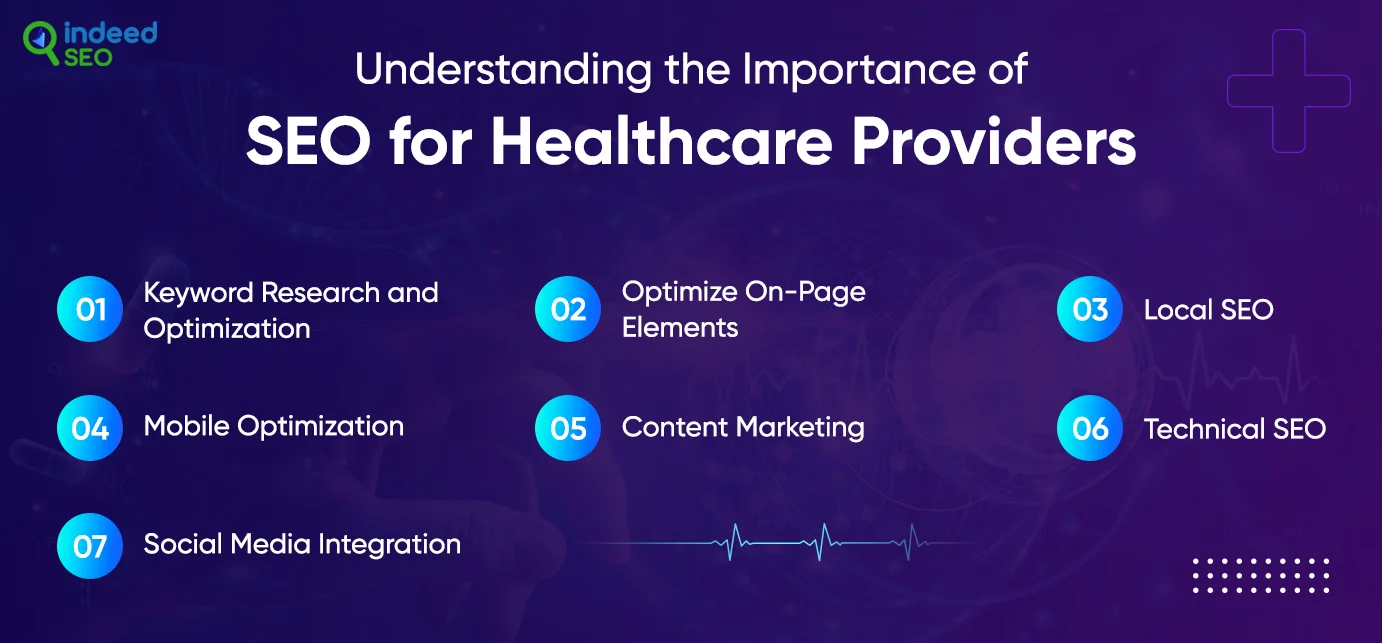
Keyword Research and Optimization
Keyword research is an important component of an efficient SEO strategy. It is the process of determining which keywords, as well as terms, patients may search for when they are looking for health solutions. This is how you can conduct keyword research:
- Find the Core Services: The first step is to list the primary services that your health institution provides, for example, regular practice, dental treatment, and physiotherapy, as well as the mental health service.
- Utilize Keyword Tools: Use Keyword research tools like Google Keyword Planner, Ahrefs, and SEMrush to identify pertinent keywords that have high search volume and little competition.
- Keywords with Long Tails: The focus should be on the longer-tail keywords. These are more precise and longer terms. They are often less competitive and have a higher rate of conversion. As an example, instead of using “dentist,” consider targeting “accurate dentist in Sydney for root canal treatment.”
- Local Keywords: Use location-specific keywords that target local patients. Examples include “physiotherapist in Melbourne” or “bulk billing GP in Brisbane.”
Optimize On-Page Elements
On-page SEO is about optimizing the various elements of your website in order to increase the search engine rankings of your site. The most important elements on your website to concentrate on are:
- Title Tags: Make captivating and relevant titles for every page. Be sure that they accurately convey the material and contain your main keyword.
- Meta Descriptions: Write engaging meta descriptions to entice people to click through your hyperlink. Use relevant keywords, and include clearly stated calls to take action.
- Header Tags: Utilize header tags (H1, H2, and H3) to organize your material to make it simpler for engines to read. Use keywords naturally inside the headers.
- Content Optimization: Create high-quality and relevant material that meets the demands and needs of your intended audience. Make sure the material is researched and original and is free of plagiarism.
- URL Structure: Utilize clear and concise URLs that contain pertinent keywords. Do not use long or complex URLs.
- Image Optimization: Enhance the quality of images by compressing them to allow for quicker loading speeds, as well as including descriptive alt text that contains keywords.
Local SEO
Local SEO is especially important to healthcare professionals since patients frequently search nearby for medical facilities. Here are some ways to increase the local SEO of your business:
- Google My Business (GMB): Claim and improve your GMB listing. Make sure that the name of your company and address, as well as your phone number (NAP) and working hours, are correct. Inspire satisfied customers to leave positive reviews.
- Local Citations: Check that your company’s details are consistent across a variety of online directories and citation websites like Yelp, HealthEngine, and True Local.
- Local Content: Make material specifically designed for a local population. It could be blog posts regarding local health-related events or partnerships with local businesses, as well as health-related tips specific to your local area.
- Localized Keywords: Include local keywords in your site’s content, Meta tags, as well as the GMB list.
Mobile Optimization
In the age of increasing usage of smartphones and smartphones, it’s crucial to ensure your website is mobile-friendly. Google will also give priority to mobile-friendly sites when it ranks websites in search results. Here’s how to optimize websites for mobile devices:
- Responsive Design: Utilize a flexible design that auto-adapts to the different sizes of screens and gives users a seamless experience for desktops as well as mobile devices.
- Speedy loading times: Make sure your site is responsive for mobile devices by optimizing your images, using the caching capabilities of your browser, and decreasing redirects.
- Mobile-Friendly Navigation: Simplify navigation to mobile users with simple menus, big buttons, and simple-to-read fonts.
Content Marketing
Content marketing is an effective method to draw and engage prospective patients and improve your Search engine Optimization. Here are a few material marketing techniques to benefit healthcare professionals:
- Blogging: Create a regular, up-to-date blog that addresses the most common issues with health, offers medical guidance, and provides recent news about healthcare. Utilize keywords naturally in the blog’s content.
- Patient education: Create educational material, including videos, articles, or informational graphics, that inform patients of different health issues, treatment options, and prevention measures.
- FAQs: Create a complete FAQ page that answers commonly asked questions by patients. It can boost the user experience as well as boost the search engine rankings.
- Case studies and testimonials: Sharing positive experiences and stories of happy customers to establish confidence and trust.
Technical SEO
The process of optimizing the web’s backend in order to boost its efficiency and ensure that search engines are able to crawl and index your website. Important elements of technical SEO comprise:
- Speed of your site: Enhance your website’s loading speed by optimizing images and material delivery network (CDN), as well as reducing JavaScript and CSS files.
- XML Sitemap: Make and send an XML sitemap for search engines, in order to help search engines understand your website’s layout and index your web pages effectively.
- Robots.txt: Use a robots.txt file to determine what areas of your website search engines are able to crawl and search.
- Secure Site (HTTPS): Ensure your website is HTTPS-enabled to deliver an encrypted connection that can also be an important ranking factor to Google.
- Repair broken links: Check regularly for broken links and repair them to ensure users have a pleasant experience. This will also keep Google from penalizing your website.
Social Media Integration
Social media is a great way to enhance your SEO by driving more traffic to your site and increasing your website’s visibility. How to integrate social media in the SEO strategy:
- Engagement Content: Post relevant and useful material via social media platforms to engage your target audience.
- Social Share Buttons: You can add social sharing buttons on your blog posts or other material in order to get readers to spread your material via their networks.
- Optimizing Profiles: Check that your social media accounts are current, accurate, and contain URLs to your websites.
- Local engagement: Connect with local communities as well as influencers and other organizations via social media platforms to raise your visibility locally as well as impact.
Last Thoughts
Looking for data-driven SEO strategies for your healthcare business in Australia? IndeedSEO offers the perfect SEO strategies that fit the specific needs of your healthcare provider business in Australia. Contact us now!