+1 (917) 565-8527

 info@indeedseo.com

Starting an online business like Amazon sounds ambitious. After all, Amazon operates one of the world’s largest ecommerce platforms, connects millions of buyers and sellers, and has built an extensive logistics network.
However, you don’t need to recreate Amazon to build a successful ecommerce business. You need to understand its business model and start at a manageable scale.
In 2027, entrepreneurs can launch an online store, create a multi-vendor marketplace, or develop a niche ecommerce platform without investing millions of dollars.
Platforms such as Shopify, WooCommerce, CS-Cart, and Sharetribe have made ecommerce development more accessible. Meanwhile, AI shopping assistants, including Alexa for Shopping, ChatGPT, and Gemini, are changing how customers discover and compare products.
This guide explains how to start an online business like Amazon, including business models, website development costs, ecommerce software, legal requirements, payment systems, logistics, and AI-powered shopping trends.
Whether you’re launching in India or the United States, the most important decision is choosing the right business model before investing in technology.
Key Takeaways
- Building an Amazon-style business does not require Amazon’s infrastructure. Start with a niche ecommerce store and expand when demand is proven.
- A basic online store may cost ₹30,000–₹2,00,000 ($350–$2,300), while marketplace development requires substantially more investment.
- Shopify and WooCommerce suit single-seller stores; dedicated marketplace software supports multiple independent vendors.
- Amazon’s Alexa for Shopping and emerging AI commerce platforms are changing product discovery and purchasing.
- Sustainable growth depends on product margins, reliable fulfillment, customer trust, and effective ecommerce marketing.
How Amazon Actually Makes Money

Understanding the Amazon business model is essential before creating a similar business.
Amazon is more than an online retail website. It operates several interconnected revenue streams.
1. Online Retail Sales
Amazon sells products directly to consumers through its own retail operations.
Revenue comes from merchandise sales, while profitability depends on purchasing costs, logistics, inventory management, and operating expenses.
2. Third-Party Marketplace Fees
Independent sellers list products on Amazon’s marketplace.
Amazon earns revenue through seller services, including referral fees, fulfillment charges, and other applicable services.
This model allows Amazon to offer an enormous product selection without owning every item sold.
3. Advertising Revenue
Brands and marketplace sellers pay to advertise products through Amazon Ads.
Sponsored Products, Sponsored Brands, and other advertising formats help businesses reach shoppers throughout the purchasing journey.
Amazon reported approximately $19.6 billion in advertising services revenue during the third quarter of 2026.
Businesses interested in marketplace advertising can explore Amazon Ads management.
4. Prime Subscriptions
Amazon Prime generates subscription revenue while offering benefits such as shipping, entertainment, and exclusive services.
Subscriptions also encourage customer loyalty and repeat purchases.
5. Amazon Web Services
Amazon Web Services provides cloud computing and related infrastructure services.
AWS is a separate business from ecommerce retail, but contributes significantly to Amazon’s overall financial performance.
The lesson: Start with a focused retail or marketplace model. Advertising networks, subscriptions, and advanced logistics can follow after the business establishes demand.
Store, Marketplace, or Dropshipping? Choose Your Model
Before you build a website like Amazon, decide what type of ecommerce business you want to operate.
| Business model | How it works | Main advantage | Main challenge |
|---|---|---|---|
| Single-vendor store | Sell products from your own inventory or brand | Greater operational control | Inventory and fulfillment responsibilities |
| Multi-vendor marketplace | Allow independent sellers to list products | Broad product selection | Vendor management and complex technology |
| Dropshipping | Suppliers fulfill orders placed through your store | Lower upfront inventory investment | Limited control over delivery and product quality |
| Hybrid ecommerce | Combine your products with approved third-party sellers | Flexible expansion | More complicated operations |
Which Model Is Best for Beginners?
A single-vendor store is generally the simplest starting point.
You control product selection, customer experience, pricing, and brand identity.
A multi-vendor marketplace becomes attractive when you identify a category where independent sellers need access to a shared audience.
Dropshipping can reduce inventory costs, but supplier reliability and customer service remain your responsibility.
Avoid launching a general marketplace that attempts to compete with Amazon across every category.
Start with a specific customer problem, product category, or underserved market.
How to Start an Online Business Like Amazon: 10 Steps
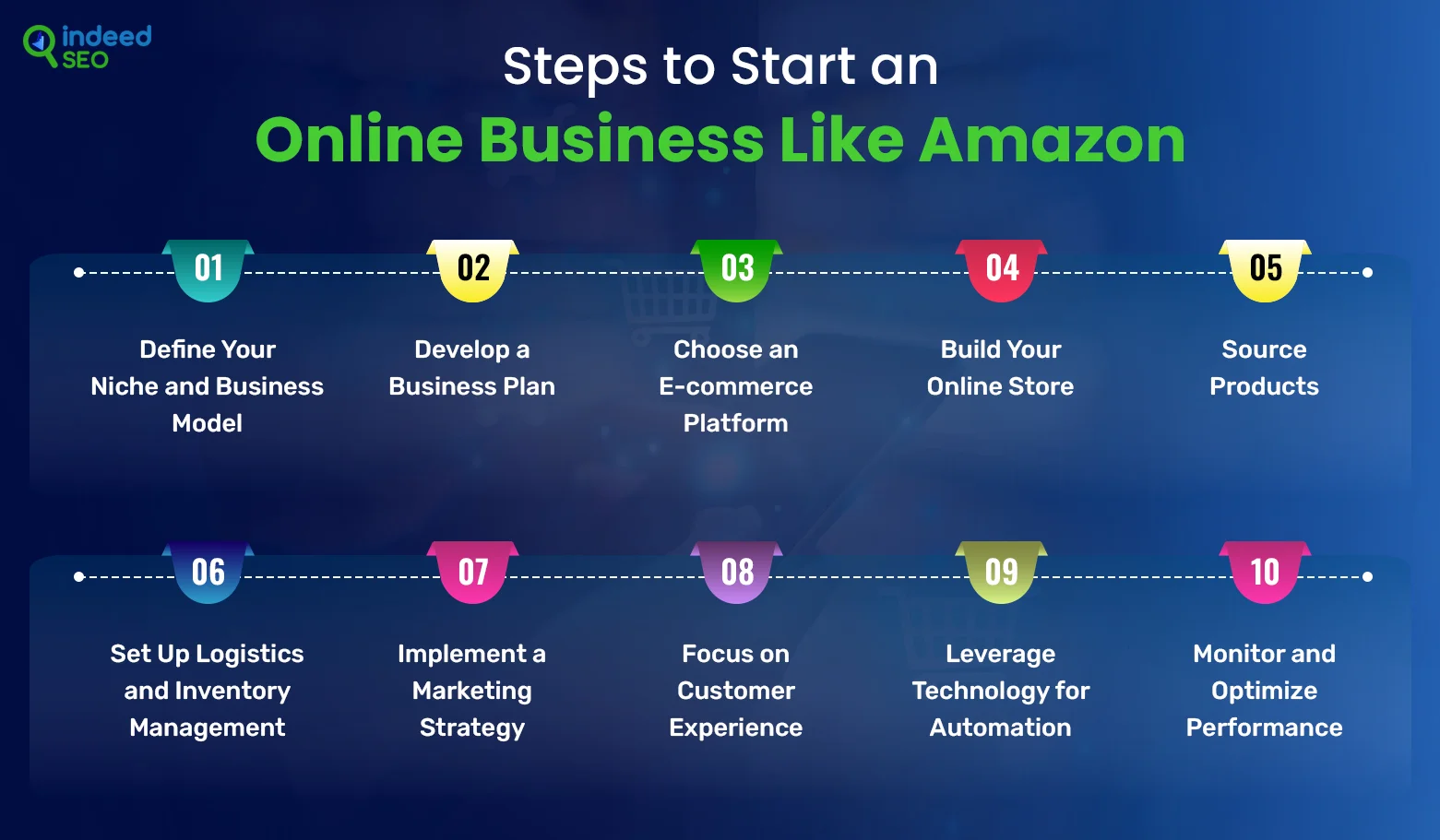
Building an ecommerce website like Amazon requires more than choosing a domain name and uploading products.
Follow these ten steps to establish a practical foundation.
1. Validate a Profitable Ecommerce Niche
Successful ecommerce businesses begin with a defined audience.
Instead of creating an everything store, research a particular category.
Examples include sustainable home products, specialized pet accessories, educational supplies, or regional handmade goods.
Evaluate:
- Customer demand and recurring needs.
- Existing competitors.
- Product acquisition costs.
- Shipping requirements.
- Expected gross margins.
- Return and replacement rates.
Google Trends, marketplace category reports, and customer interviews can help identify potential opportunities.
Before investing heavily, test demand with a limited product range.
2. Register Your Ecommerce Business
Legal requirements differ between India and the United States.
Starting an ecommerce business in India
Choose an appropriate business structure, such as a sole proprietorship, partnership, LLP, or private limited company.
Depending on your activities, you may require GST registration, appropriate business registrations, and product-specific licenses.
Marketplace operators and sellers should examine GST registration and tax collection at source requirements. Special exemptions and conditions may apply to eligible suppliers.
Starting an ecommerce business in the US
Common structures include sole proprietorships and LLCs.
You may need an Employer Identification Number, local permits, and sales tax registrations.
US sales tax obligations depend on state rules and economic or physical nexus.
Consult a qualified accountant or legal professional before launching.
3. Choose the Best Ecommerce Platform
Selecting the right software is one of the most important decisions when building a website like Amazon.
The best platform depends on whether you want a simple online store or a marketplace with multiple vendors.
| Platform | Best suited for | Important considerations |
|---|---|---|
| Shopify | Beginners and growing brands | Subscription pricing, hosted infrastructure |
| WooCommerce | WordPress-based ecommerce | Flexible, but requires hosting and maintenance |
| Dokan | WordPress multi-vendor marketplaces | Requires WooCommerce and suitable extensions |
| CS-Cart Multi-Vendor | Dedicated marketplaces | Vendor tools and licensing costs |
| Sharetribe | Service and niche marketplaces | Marketplace workflows and subscription costs |
| Custom development | Complex enterprise marketplaces | High development and maintenance costs |
Shopify vs. WooCommerce
Shopify provides managed hosting, payment integrations, themes, and an established app ecosystem.
WooCommerce is open-source ecommerce software built for WordPress. Its core platform has no licensing fee, but hosting, extensions, security, and development may involve additional expenses.
Shopify’s US Basic plan was listed at $29 per month when billed annually in late 2026. Regional pricing and promotions vary.
For marketplace functionality, WooCommerce can be extended with plugins such as Dokan.
However, a serious multi-vendor business may benefit from dedicated marketplace software.
If you choose Shopify, professional Shopify SEO services can help maintain search-friendly product architecture as your catalog expands.
Avoid purchasing a cheap Amazon clone without evaluating security, scalability, licensing, and long-term support.
4. Set Up Secure Payment Systems
Customers expect convenient and secure payment options.
For Indian ecommerce businesses, commonly considered options include Razorpay, PayU, UPI-based payments, and cash on delivery.
In the United States, payment providers include Stripe, PayPal, and other merchant services.
Before selecting a payment gateway, compare transaction charges, settlement periods, chargeback procedures, refund handling, and supported currencies.
Multi-vendor marketplaces also need reliable seller settlement and commission accounting.
Never store sensitive card information unnecessarily. Use compliant payment infrastructure and follow applicable data protection requirements.
5. Source Products or Onboard Sellers
Product sourcing depends on your chosen business model.
Single-vendor stores typically work with manufacturers, wholesalers, or direct suppliers.
Marketplaces must recruit and verify independent sellers.
A reliable vendor onboarding process should include business verification, product quality expectations, commission agreements, payment terms, and dispute-resolution procedures.
Avoid adding hundreds of sellers before establishing consistent operating standards.
Customer trust depends on the quality of every order, regardless of which seller fulfills it.
6. Build Logistics and Returns Infrastructure
Efficient logistics are fundamental to ecommerce success.
In India, businesses may evaluate services such as Shiprocket, Delhivery, and other delivery partners.
US businesses can consider third-party logistics providers and established carrier networks.
Amazon sellers may also evaluate Fulfillment by Amazon (FBA), subject to its fees and eligibility rules.
Your logistics plan should address:
- Packaging and dispatch timelines.
- Delivery coverage.
- Shipment tracking.
- Failed delivery attempts.
- Reverse logistics.
- Refund and replacement policies.
Clearly communicate expected delivery times before checkout.
Fast delivery promises mean little if your business cannot fulfill them consistently.
7. Build the Features That Matter
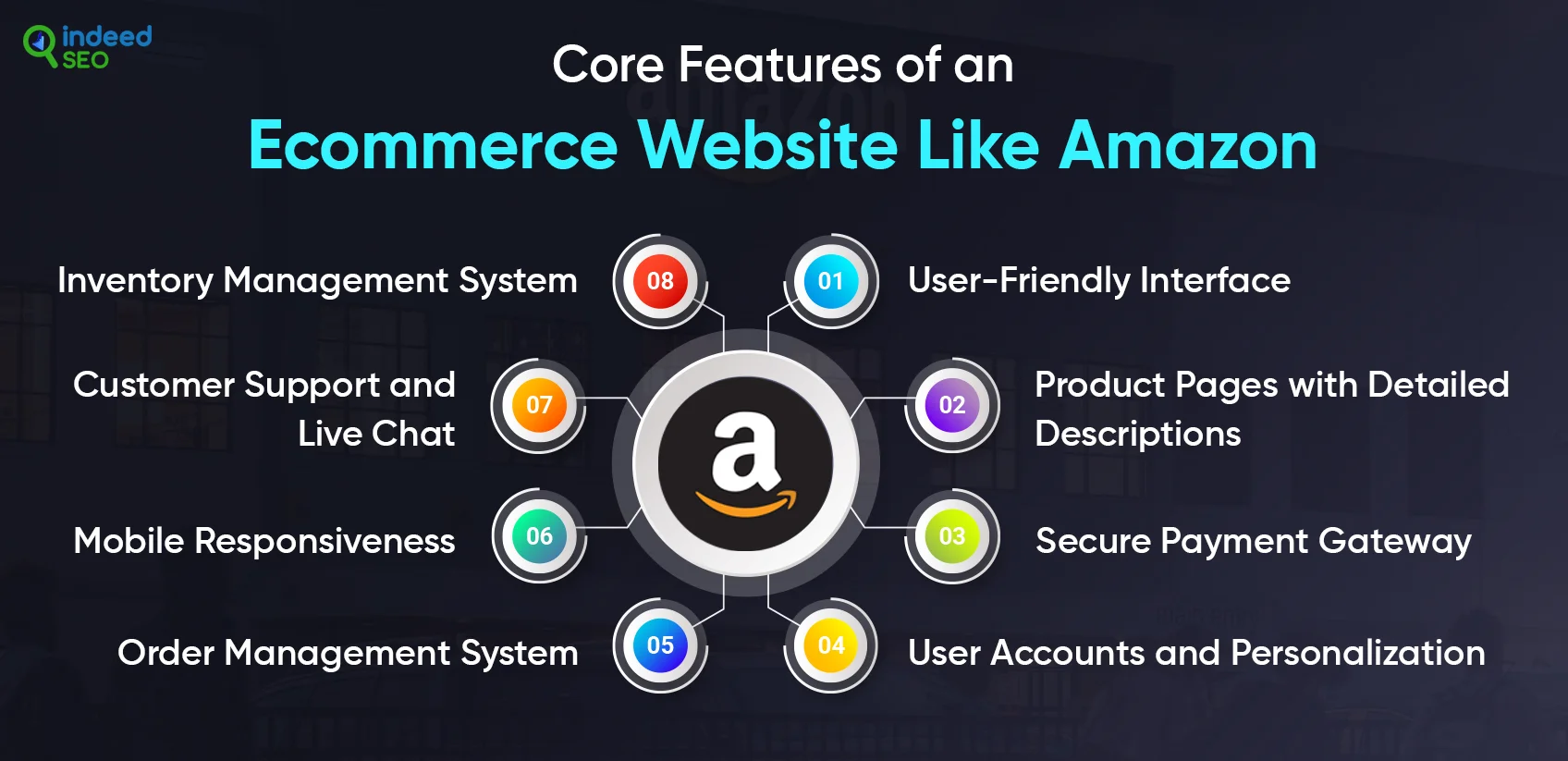
An ecommerce website like Amazon needs functional shopping features, not unnecessary complexity.
Essential capabilities include product search, category filters, product images, customer accounts, secure checkout, order tracking, reviews, and customer support.
For marketplaces, add seller dashboards, inventory controls, commission management, and dispute handling.
Advanced features such as personalized recommendations and one-click purchasing can be introduced later.
Mobile usability is especially important because many customers browse and purchase through smartphones.
Before launch, conduct a technical SEO audit to identify broken pages, indexing issues, loading problems, and mobile usability errors.
8. Create an Ecommerce Marketing Strategy
Even a technically excellent online store needs a customer acquisition strategy.
Begin with ecommerce SEO to improve the discoverability of product categories and helpful informational pages.
Create descriptive product titles, original descriptions, relevant internal links, and accurate structured data.
An established search engine optimization strategy can support long-term organic visibility.
Other channels include:
Google Shopping and search advertising: Useful for eligible products when campaigns, product feeds, and budgets are properly managed.
Explore Google Ads management for professional campaign support.
Social media marketing: Publish useful product demonstrations, customer stories, and educational content.
Consistent social media marketing helps develop brand recognition and customer relationships.
Email marketing: Build permission-based customer lists for announcements, useful updates, and retention campaigns.
Measure performance instead of investing equally across every marketing channel.
9. Make Your Products AI-Ready
In 2027, businesses should prepare for customers discovering products through AI shopping assistants.
ChatGPT, Gemini, and Alexa for Shopping are increasingly important examples of conversational product discovery.
To improve your website’s readiness, maintain accurate product titles, specifications, pricing, availability, shipping information, and return policies.
Use appropriate Product structured data and merchant feeds where supported.
Publish useful answers to product questions, including compatibility, sizing, materials, and intended use.
Shopify has introduced agentic storefront capabilities that allow eligible products to become discoverable through supported AI channels.
However, product eligibility does not guarantee a recommendation or placement.
Explore GEO marketing and answer engine optimization to understand how structured information supports AI-powered discovery.
10. Track Your Ecommerce Performance
Launching a store is only the beginning.
Track the metrics that indicate whether the business can grow sustainably.
| Metric | What it measures |
|---|---|
| Customer acquisition cost (CAC) | Average cost of acquiring a customer |
| Average order value (AOV) | Revenue per order |
| Gross margin | Revenue remaining after product costs |
| Conversion rate | Percentage of visits resulting in orders |
| Repeat purchase rate | Customers returning for another purchase |
| Return rate | Orders returned or refunded |
For example, if acquiring a customer costs ₹400 but the order contributes only ₹250 before acquisition expenses, the business needs better margins, retention, or acquisition efficiency.
Focus on contribution profit rather than revenue alone.
How Much Does It Cost to Build a Website Like Amazon?
The cost to build a website like Amazon depends on the technology, number of sellers, functionality, integrations, and development approach.
You can launch a simple ecommerce store with a modest budget. Creating a sophisticated multi-vendor marketplace requires significantly more investment.
The following are illustrative planning estimates, not vendor quotations. Dollar figures are rounded equivalents using approximately ₹87 per US dollar, rather than a live exchange rate.
| Business type | Estimated cost in India | Approximate USD |
|---|---|---|
| Starter ecommerce store | ₹30,000–₹2,00,000 | $350–$2,300 |
| Multi-vendor marketplace | ₹3,00,000–₹15,00,000 | $3,450–$17,250 |
| Custom marketplace platform | ₹20,00,000–₹1,00,00,000+ | $23,000–$115,000+ |
Starter Ecommerce Store
A basic store typically includes a domain, theme, hosting or platform subscription, payment integration, and essential product pages.
It suits businesses validating their first product category.
Inventory, advertising, and ongoing operating expenses should be budgeted separately.
Multi-Vendor Marketplace
A marketplace requires seller accounts, vendor onboarding, commissions, catalog moderation, settlement processes, and additional support systems.
Costs rise when the project includes custom integrations or advanced inventory management.
Custom Amazon-Style Platform
A custom marketplace may require dedicated engineering, infrastructure, security testing, and ongoing maintenance.
The cost can increase substantially for international operations, high transaction volumes, and complex fulfillment systems.
Important: Website development cost is not the same as total business investment. Include inventory, staffing, logistics, legal compliance, payment fees, and marketing when preparing your budget.
What’s Changing for Amazon-Style Businesses in 2027?
AI shopping, automated purchasing, conversational advertising, and changes in marketplace fees are reshaping ecommerce.
Here are five developments worth monitoring.
1. Alexa for Shopping Is Changing Product Discovery
Amazon renamed its Rufus shopping assistant Alexa for Shopping in May 2026.
The assistant helps shoppers research products, compare alternatives, explore pricing information, and receive personalized suggestions.
Rather than searching for a specific product name, customers can ask questions such as:
“What is a suitable office chair for a small apartment?”
AI-powered recommendations can consider product information, customer preferences, and available shopping data.
For businesses, this reinforces the importance of accurate product descriptions, genuine reviews, and complete product information.
However, recommendation behavior varies by market and customer context.
2. Amazon Buy for Me Introduces Agentic Commerce
Amazon’s Buy for Me functionality allows eligible US shoppers to purchase selected products from external merchant websites through Amazon’s shopping experience.
The feature forms part of Amazon’s broader effort to help customers discover products outside its own marketplace.
This is an example of agentic commerce, where an AI-enabled shopping system assists with actions beyond product research.
Independent stores should monitor eligibility and merchant requirements.
Being discoverable through external shopping experiences does not guarantee inclusion in Buy for Me.
Businesses can also explore ChatGPT SEO to understand other AI product discovery environments.
3. AI Conversations Are Becoming Advertising Surfaces
Amazon introduced Sponsored Products prompts and Sponsored Brands prompts to bring product-related information into AI-assisted shopping experiences.
In September 2026, Amazon announced Branded Conversations, scheduled to launch in the United States in January 2027.
The feature is designed to allow shoppers to enter multi-turn, brand-informed conversations from eligible Sponsored Brands advertisements.
Availability is initially limited to eligible US advertisers.
Businesses evaluating these formats should understand reporting, campaign eligibility, and advertising costs.
See Amazon Ads management and this guide to Amazon PPC costs.
4. Amazon India Seller Fees Continue to Change
Amazon India expanded zero-referral-fee eligibility to a large number of products priced at ₹1,000 or below.
However, this does not mean every product or transaction is fee-free.
Closing fees, shipping charges, fulfillment fees, and other applicable costs can still affect profitability.
Amazon also updated certain closing fees effective September 7, 2026.
Before listing products, use the official Amazon India seller fees page and calculate category-specific charges.
Review the fee schedule again before making 2027 pricing decisions.
5. Trust and Privacy Can Differentiate Independent Stores
Independent ecommerce businesses can build trust through transparent policies and personalized service.
Clear pricing, authentic reviews, responsive customer support, and straightforward returns reduce uncertainty.
Protect customer information and avoid exaggerated product claims.
Professional online reputation management services can support broader brand trust initiatives.
Build Your Own Site, Sell on Amazon, or Both?
Choosing between an independent store and Amazon’s marketplace depends on your goals.
| Factor | Own ecommerce website | Amazon marketplace | Buy for Me eligibility |
|---|---|---|---|
| Brand control | High | Limited by Amazon policies | Merchant retains its own storefront |
| Customer relationship | Direct | Platform-mediated | Depends on the transaction experience |
| Initial development | Required | Usually minimal | Existing merchant website needed |
| Customer acquisition | Your responsibility | Access to marketplace shoppers | Potential AI-assisted discovery |
| Fees | Platform, payments, logistics | Seller and fulfillment charges | Eligibility and applicable terms |
| Availability | Broad | Supported seller markets | Selected eligible experiences |
For many businesses, a hybrid strategy makes sense.
Sell through Amazon where commercially appropriate while developing an independent website that supports your brand and customer relationships.
This reduces dependence on a single channel.
Amazon’s advertising solutions may support eligible marketplace campaigns, while your own store gives you greater control over website design, customer communications, and long-term brand development.
Your First 90 Days: Ecommerce Launch Plan
A realistic launch roadmap helps prevent unnecessary spending.
| Timeline | Main priorities |
|---|---|
| Days 1–15 | Research the niche, customers, products, and competition |
| Days 16–30 | Register the business, evaluate suppliers, choose a platform |
| Days 31–45 | Build the store, integrate payments, configure shipping |
| Days 46–60 | Upload products, test checkout, finalize policies |
| Days 61–75 | Launch marketing, improve product pages, collect feedback |
| Days 76–90 | Review sales, margins, returns, and customer acquisition |
By day 90, aim to understand your operating costs and whether customers genuinely value your products.
Do not expand your catalog simply because the technology allows it.
Conclusion: Build a Business That Can Grow Beyond Its First Store
You do not need Amazon’s enormous infrastructure to start a successful ecommerce business in 2027.
Begin with a profitable niche, choose appropriate technology, build reliable fulfillment processes, and develop customer trust.
As the business grows, you can expand from a single-vendor store into a multi-vendor marketplace while preparing for AI-powered commerce.
Whether you need ecommerce SEO, paid advertising, marketplace optimization, or AI search visibility, a structured marketing strategy can support sustainable growth.
Ready to grow your ecommerce business? Request a consultation to discuss your website, marketing, and growth requirements.

Frequently Asked Questions
1. How much does it cost to build a website like Amazon?
A basic ecommerce website in India may cost approximately ₹30,000–₹2,00,000. A multi-vendor marketplace may require ₹3 lakh–₹15 lakh, while custom marketplace development can exceed ₹20 lakh. Costs vary according to design, technology, integrations, security, and ongoing maintenance.
2. Can I start a business like Amazon with little money?
Yes. You can begin with a small niche store using hosted ecommerce software or an existing marketplace. Minimize unnecessary custom development, validate customer demand, and reinvest profits gradually. Inventory, shipping, marketing, and operational costs still require careful budgeting.
3. Which platform is best for a multi-vendor marketplace like Amazon?
Dokan, CS-Cart Multi-Vendor, and Sharetribe are options worth evaluating. Shopify and WooCommerce are often simpler for single-vendor ecommerce. The best choice depends on vendor management, payment splitting, commission rules, scalability, and your development budget.
4. How long does it take to build an ecommerce website like Amazon?
A basic ecommerce store may take several weeks, depending on product readiness and integrations. A more complex marketplace may require several months. Custom platforms can take considerably longer because of seller workflows, security, logistics integrations, and extensive testing.
5. Do I need GST to sell online in India?
GST requirements depend on the business model, turnover, location, products, and whether sales occur through an ecommerce operator. Marketplace operators face additional obligations. Certain exemptions may apply to eligible suppliers. Consult a tax professional before launching.
6. Is it better to sell on Amazon or my own website?
Amazon offers access to established marketplace infrastructure, while an independent website provides greater control over branding and customer relationships. Many businesses use both channels to diversify revenue and reduce dependence on a single platform.
7. What Is Amazon Alexa for Shopping, formerly Rufus?
Alexa for Shopping is Amazon’s AI-powered shopping assistant, formerly called Rufus. It helps customers research products, compare options, and make shopping decisions. Accurate listings and product information are important, but no business can guarantee an AI recommendation.
8. What is Amazon Buy for Me?
Buy for Me is an Amazon shopping feature that can help eligible US customers purchase selected products from external merchant websites. Availability is limited and subject to Amazon’s eligibility rules. Store inclusion should not be assumed.
9. Did Amazon India remove referral fees in 2026?
Amazon India expanded zero-referral-fee eligibility for numerous products priced at ₹1,000 or below. However, eligible categories and price conditions matter, and sellers may still incur closing, shipping, fulfillment, and other charges. Always verify the current fee schedule.
10. How do I get my products recommended by ChatGPT or Gemini?
Maintain accurate product information, valid structured data, updated inventory, competitive and transparent pricing, and clear merchant policies. Use supported product feeds and commerce integrations where available. These practices improve technical readiness but do not guarantee AI visibility.