+1 (917) 565-8527

 info@indeedseo.com

Before you spend a dollar on dental PPC, work out one number: what a new patient is worth to your practice.
Everything else follows from it: how much you can pay for a click, how many calls you need, and whether pay-per-click can work for you at all. Most dental PPC advice skips this and jumps straight to “set a budget.” This guide goes the other way. We’ll build the math step by step, with one imaginary practice, and then cover the privacy and advertising rules that apply to dentists.
(The practice and its numbers below are an illustration, not a benchmark. Your rates will be different, and the point is how to calculate them.)
Step 1: What is a new patient worth?
Take the average revenue a new patient brings in over their first year, then decide what share of it you’re willing to spend to win them.
For our example practice:
- First-year value of a new patient: $1,500
- Share we’ll spend to win one: 20%
- Allowable cost per new patient: $300
That $300 is your ceiling. Spend more than that to get a patient, and PPC loses you money in year one. (If patients stay for years, you may choose a higher share. That’s a decision for you and your accountant.)
Step 2: Work backwards from click to patient

Between a click and a new patient there are three steps, and each loses people:
- Click to enquiry: the share of visitors who call or fill in a form
- Enquiry to booking: the share of enquiries who book an appointment
- Booking to new patient: the share who turn up and become patients
Multiply them and you get the share of clicks that become patients.
Version A: the starting point (illustration)
| Step | Rate |
|---|---|
| Click to enquiry | 8% |
| Enquiry to booking | 50% |
| Booking to new patient | 60% |
| Click to new patient | 8% × 50% × 60% = 2.4% |
With a click price of $8, the cost per new patient is $8 ÷ 0.024 = about $333. That’s slightly above our $300 ceiling. The campaign is close, but it loses money.
Step 3: Fix the funnel before you raise the budget
Here’s the most useful lesson in dental PPC: you often improve results more by fixing the steps after the click than by changing the ads.
Version B: a better landing page. Suppose a page that matches the ad, loads fast on a phone and has a clear call button lifts click-to-enquiry from 8% to 10%.
Click to patient is now 10% × 50% × 60% = 3%. Cost per new patient: $8 ÷ 0.03 = about $267. That’s under the ceiling.
Version C: better call handling. Now suppose the front desk answers or calls back within minutes, and enquiry-to-booking rises from 50% to 60%.
Click to patient is 10% × 60% × 60% = 3.6%. Cost per new patient: $8 ÷ 0.036 = about $222.
Same ads, same click price, and the cost per patient dropped by a third. That’s why we look at the funnel before the bid.
Step 4: Turn the math into a budget

Now work forwards. Say the practice wants 10 new patients a month, using Version B:
- Clicks needed: 10 ÷ 0.03 = about 333
- Cost of those clicks: 333 × $8 = about $2,667 a month
That number comes from the practice’s own value, rates and click prices, not from a rule of thumb. If your numbers are different, plug them in:
- Cost per patient = click price ÷ (click-to-enquiry × enquiry-to-booking × booking-to-patient)
- Clicks needed = patients wanted ÷ click-to-patient rate
- Monthly budget = clicks needed × click price
Google’s budget settings work as averages. On a given day Google may spend up to about twice your daily budget, and your monthly total is capped at roughly 30.4 times your average daily budget. Our guide to how much Google Ads cost explains the auction.
What do dental clicks really cost?
Click prices vary a lot by treatment and by city. Here are the estimated average prices in Semrush’s US database for common patient searches:
| Search | Estimated cost per click |
|---|---|
| dental implants | $11.06 |
| orthodontist near me | $10.02 |
| dentist near me | $8.30 |
| family dentist near me | $6.52 |
| emergency dentist near me | $6.86 |
| cosmetic dentist near me | $6.26 |
| invisalign | $4.73 |
| teeth whitening | $2.95 |
These are national estimates, not quotes. Your local price can be far higher in a big city and lower in a small town. Use Google Ads’ Keyword Planner for your area, and expect to test.
Two lessons: high-value treatments cost more per click, which is fine if each patient is worth more, and a cheap click isn’t a good one if it brings people who’ll never book.
Where the budget leaks
Four leaks cause most dental PPC waste:
- The wrong searches. This is what negative keywords fix. They tell Google which searches you don’t want, such as “dental school,” “dentist salary” or “free dental care.” Check the search terms report weekly and add negatives for searches that won’t become patients. Negative keywords don’t match close variants, so add singular and plural forms yourself.
- A weak landing page. Don’t send people to a homepage. Send “emergency dentist” clicks to a page about emergency visits, with hours, a call button and what to expect.
- Missed calls. An ad can’t fix a phone nobody answers. Decide who answers, when, and what happens after hours.
- The wrong area or time. Target the places you actually serve, and show call-focused ads when the phones are staffed.
For help with the ad-account side, see our Google Ads campaign management checklist, and for the page side, our guide to raising your website’s conversion rate.
Tracking: count patients, not clicks
Set up conversion tracking so Google Ads records the actions that matter. Google says it can record phone calls from ads, calls to the number on your site, and taps on a number on mobile, as well as form submissions. It’s also what lets Smart Bidding work, and Google suggests judging that over a month or more with at least 30 conversions.
Better still, connect your tracking to what happens afterwards. Ask every new patient how they found you, and log whether a booked appointment became a patient. Those last two numbers are the ones that decide whether PPC pays.
Privacy and the rules that apply to dentists
This part matters more for dentists than for most advertisers. It’s general information, not legal advice, so check with counsel and your state dental board.
- Google’s rules on health. Google treats health as a sensitive interest category. For these categories, advertiser-curated audiences, such as Customer Match, your own data segments and lookalike audiences, aren’t allowed, and ads can’t collect personal information like emails or phone numbers unless they use Google-provided formats. Google’s predefined audiences remain available. Read Google’s current policy before you build remarketing.
- Patient privacy. Health privacy rules can apply to dental practices. Be careful about putting tracking tools on pages where patients enter health details, and about what your forms and call tracking collect. Ask your counsel to review your setup.
- Advertising honesty. The ADA’s Code says a dentist’s advertising can’t be false or misleading in a material respect, and 2025 updates extend that to what influencers say for a practice. States have their own rules and penalties, and some set specific wording for specialists. Substantiate claims like “best dentist” and “pain-free,” and check how your board treats free offers and before-and-after photos.
- Honest reviews. Don’t offer rewards for reviews or hide negative ones.
Do it yourself or hire help?
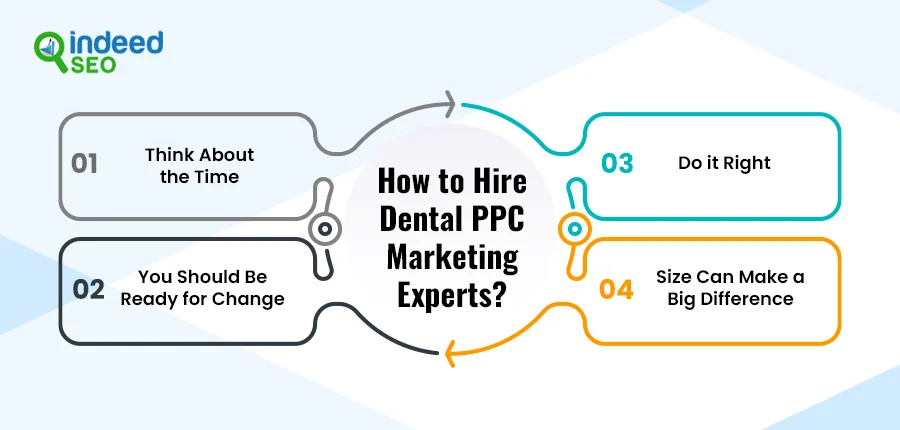
A small practice can run a simple Search campaign for one or two treatments, as long as someone checks it weekly and the front desk can handle the extra calls. Help makes sense when your spend is large enough that mistakes are costly, when you advertise many treatments, or when nobody has the time.
If you hire help, ask:
- Who owns the ad account? It should be you.
- How will you report patients and appointments, not just clicks?
- How do you handle patient privacy and tracking?
- Which claims will you put in my ads, and who checks them against our board’s rules?
- What does the fee cover, and how long is the contract?
Beware of promises like “30 leads for $499” or “guaranteed results.” Nobody controls Google’s auction, and results depend on your area, your treatments and your front desk.
IndeedSEO runs Google Ads for practices, and our dental PPC page and pay-per-click marketing page explain how we work. We offer a free audit, and we can’t advise on privacy or advertising rules, so check those with counsel.
Questions dentists ask about PPC
What is dental PPC?
Dental PPC is pay-per-click advertising, usually on Google, where your practice appears when someone searches for a dentist or a treatment and you pay when they click your ad.
How much should a dental practice spend on PPC?
There’s no standard figure. Work it out from what a new patient is worth, the share of that value you’ll spend to win one, what clicks cost in your area, and how many of those clicks become patients. The math above shows how, and the example practice came to about $2,667 a month for ten new patients, using illustrative rates.
How much does a click cost for dental keywords?
Semrush’s US estimates range from about $2.95 for “teeth whitening” to about $11.06 for “dental implants,” with “dentist near me” at about $8.30. Your local price can differ a lot, so check Keyword Planner for your area.
How long does dental PPC take to work?
You can get clicks and calls as soon as ads run, but it usually takes weeks of testing to learn what produces booked patients. Be careful with anyone who promises results by a set date.
What are negative keywords, and why do dentists need them?
They tell Google which searches you don’t want your ads to appear for, such as “dental school,” “dentist salary” or “free dental care.” They save money and improve lead quality. They don’t match close variants, so add singular and plural forms yourself.
Which dental services work best with PPC?
High-value treatments such as implants, orthodontics and cosmetic work often justify higher click prices, and emergency visits are searched urgently. What works for you depends on your patients, your area and your competition, so test one or two treatments first.
Can dentists use remarketing?
Be careful. Google treats health as a sensitive category, and advertiser-curated audiences such as Customer Match and lookalikes aren’t allowed for it. Read Google’s current policy and ask counsel about patient privacy before you build remarketing.
Is dental PPC worth it? It can be, if the cost to win a patient is below your ceiling and your front desk handles the calls well. The funnel math shows quickly whether it works for your numbers.
Should I run a dental PPC myself or hire someone?
A small practice can run a simple Search campaign if someone checks it weekly. Hire help when mistakes are costly or nobody has time, and make sure you own the ad account and get reports on patients, not just clicks.