+1 808 999 0096

 info@indeedseo.com
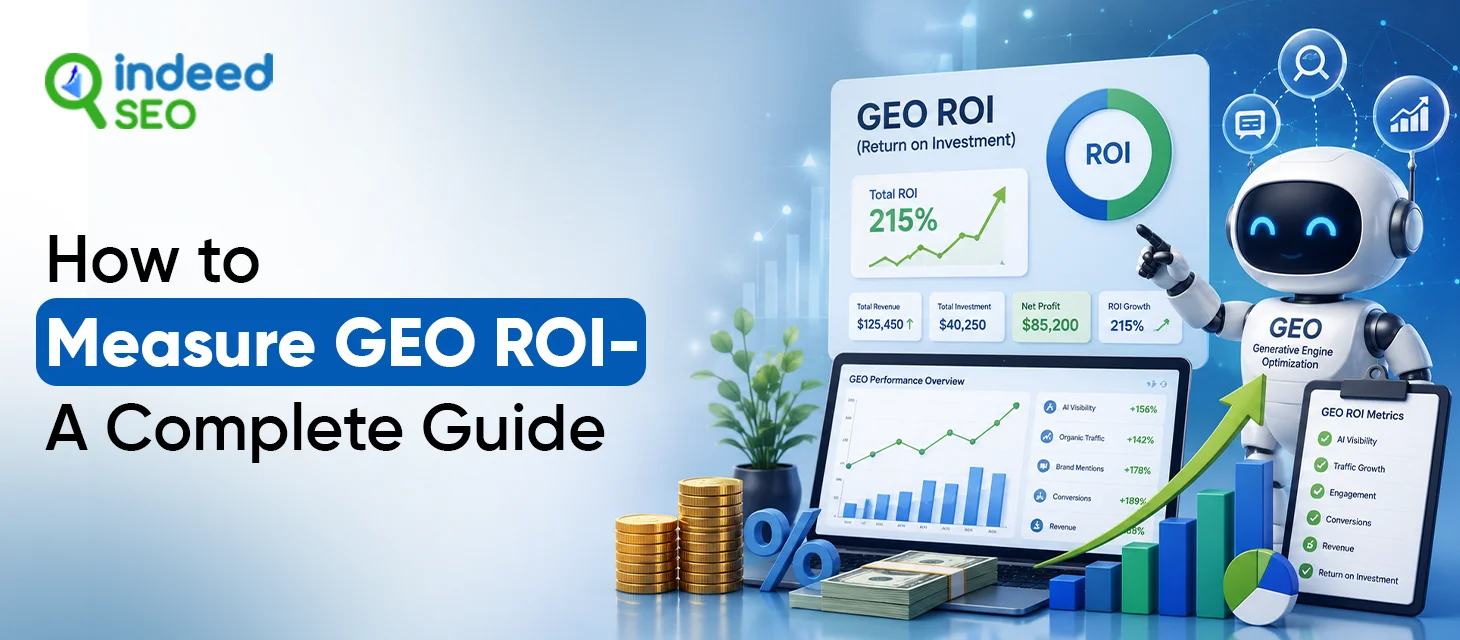
GEO (Generative Engine Optimization) ROI is measured by tracking how often your brand is cited in AI-generated answers, how much traffic those citations drive, and whether that traffic converts. Unlike traditional SEO, where clicks and rankings provide a clear paper trail, GEO success often shows up as a citation inside an AI answer, with no click involved at all. That makes ROI harder to measure using outdated techniques. This post shares a detailed guide for businesses to measure GEO ROI using updated and correct strategies.
Measure Your GEO Success with Proven ROI Tracking Methods from IndeedSEO
Why GEO ROI Measurement Is Different from SEO ROI
GEO and SEO may seem similar, but measuring their success is very different. In SEO, success is often tied to rankings, clicks, and website traffic. In GEO, your brand can create visibility and influence even when users never visit your website. That’s why GEO requires a different way of measuring ROI.
Visibility Doesn’t Always Lead to Clicks
Many AI platforms answer users’ questions directly within the conversation.
What this means:
- Users may get the information they need without visiting your website.
- Your brand can still be cited or mentioned in the answer.
- Traffic alone doesn’t show the full impact of GEO.
Attribution Is More Difficult
Unlike traditional search engines, AI platforms do not always pass referral data clearly.
What this means:
- Some AI-driven visits may not be tracked accurately.
- Referral reporting can vary between ChatGPT, Gemini, Copilot, and Perplexity.
- Measuring GEO often requires additional monitoring methods.
Citations Matter More Than Rankings
SEO focuses on where your page ranks. GEO focuses on whether AI systems choose your content as a source.
Key GEO success signals:
- Brand mentions in AI answers
- Content citations
- Source references
- AI visibility across relevant prompts
Results Can Take Longer to Appear
AI platforms do not always reference new content immediately.
What this means:
- New content may take time to be discovered and cited.
- Short-term performance checks can be misleading.
- GEO should be measured over a longer period.
GEO Creates Brand Value Beyond Traffic
A brand that is consistently mentioned by AI platforms gains visibility and credibility, even if users don’t click through to the website.
Benefits include:
- Increased brand awareness
- Stronger authority in your industry
- Higher trust among potential customers
- More opportunities to appear in future AI-generated answers
GEO Requires a Different Measurement Mindset
Treating GEO exactly like SEO is a common mistake.
Instead of tracking only:
- Rankings
- Clicks
- Organic traffic
You should also track:
- AI citations
- Brand mentions
- Share of AI voice
- AI referral traffic
- Visibility across AI platforms
Key GEO Metrics You Should Track
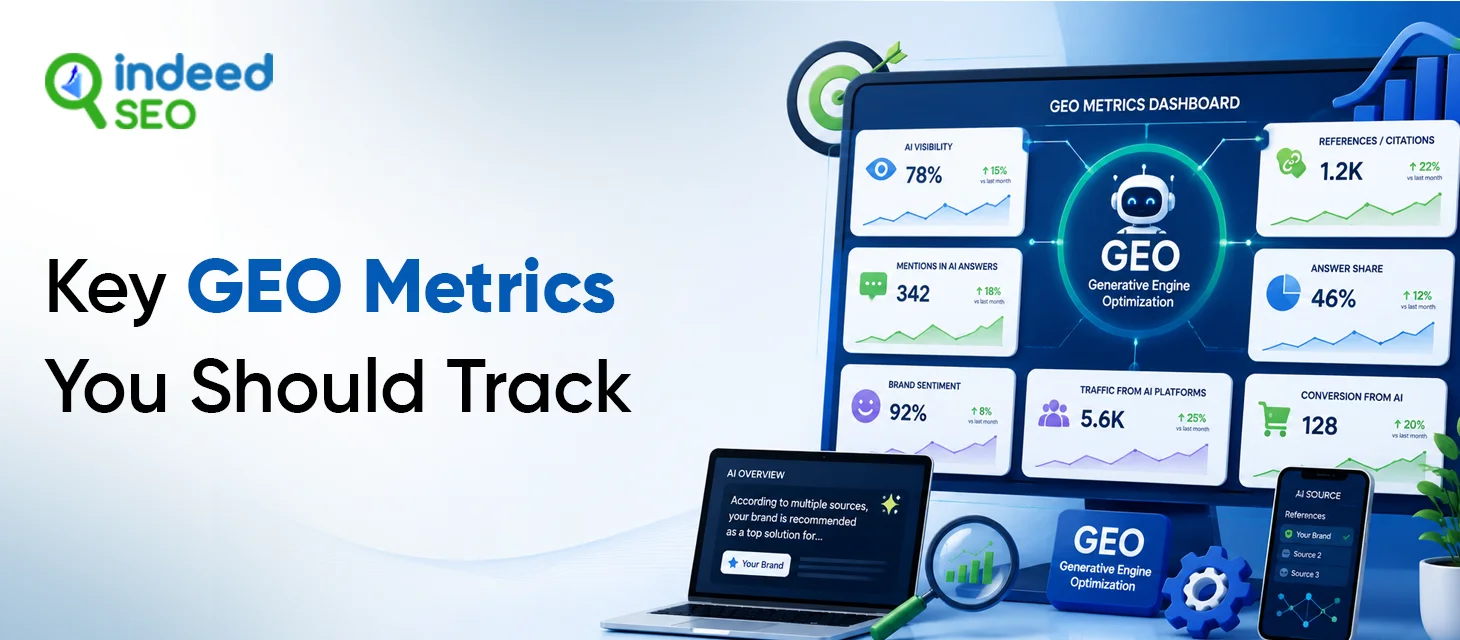
Since GEO success looks fundamentally different from SEO success, the metrics used to measure it need to differ as well. With effective GEO Marketing Services, tracking rankings and clicks alone will miss most of what GEO actually delivers. Here are the metrics that actually reflect GEO performance.
Share of AI Voice
How often your brand gets cited across AI engines compared to competitors, for the same set of target queries. This is the closest GEO equivalent to a traditional ranking position.
AI Referral Traffic
Sessions landing on your site that originated from AI platforms like ChatGPT, Perplexity, Copilot, or Gemini. Even though much of GEO’s value is zero-click, this traffic still matters and should be tracked separately from organic search.
Citation Frequency
The number of times your content is directly referenced or linked as a source within AI-generated answers, tracked across your priority queries over time.
Query Coverage
The percentage of your target queries where your content actually appears in AI-generated answers a direct measure of how much ground you’re covering versus how much is still untapped.
Content Inclusion Rate
The share of your published content that gets picked up and cited by AI engines at all. Low inclusion rates often signal content structure or authority issues, not just topic gaps.
Brand Mention Sentiment
Whether AI platforms describe your brand positively, neutrally, or negatively when referencing it since visibility alone doesn’t guarantee a favorable impression.
Answer Accuracy
Whether AI tools represent your product, pricing, or positioning correctly. Inaccurate citations can actively hurt conversions, even when visibility is high.
Time-to-Citation
How quickly new content starts getting picked up and cited after publishing a useful indicator of how “fresh” your GEO presence is across AI platforms.
Conversion Rate from AI Traffic
Of the traffic that does land on your site from AI platforms, how much of it actually converts. This separates visibility from real business value.
Competitor Share of Voice
This includes how your citation rate compares to competitors for the same queries. It is crucial for understanding relative GEO performance, not just absolute numbers.
Step-by-Step Process to Measure GEO ROI
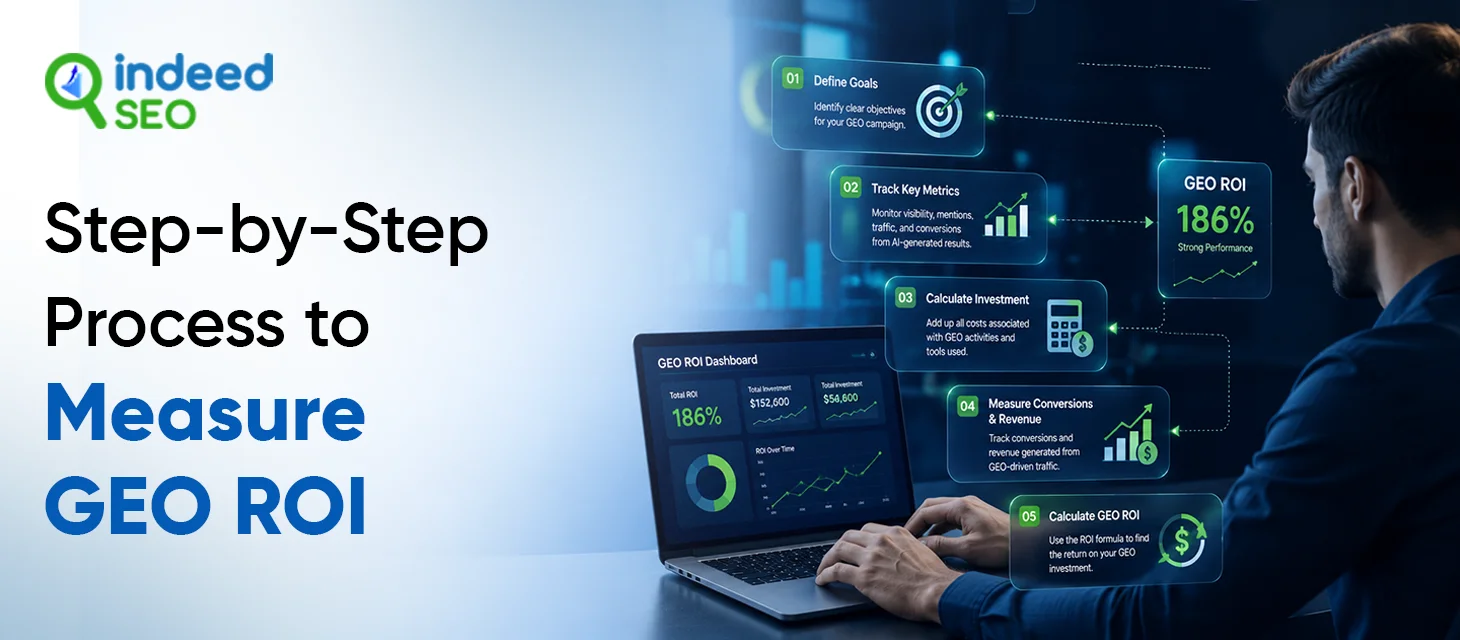
Tracking GEO ROI becomes considerably simpler when you use an organized approach. Instead of relying on a single statistic, you should assess visibility, traffic, conversions, and commercial results simultaneously. Here’s a simple step-by-step approach to determining the real ROI of GEO efforts.
Step 1: Define Your GEO Goals
Start by deciding what success looks like for your business.
Common GEO goals include:
- Brand awareness
- Lead generation
- Website traffic
- Sign-ups
- Sales and revenue
Your goals will determine which metrics you need to track.
Step 2: Establish a Baseline
Before making any GEO improvements, record your current performance.
Track your current:
- AI citations
- Brand mentions
- AI referral traffic
- Conversion rates
- Share of AI voice
This gives you a benchmark for measuring future growth.
Step 3: Identify Your Target Queries
Create a list of the questions and prompts your target audience is likely asking AI platforms.
Focus on:
- Industry-related questions
- Product and service queries
- Comparison searches
- Problem-solving prompts
These are the queries where you want your brand to appear.
Step 4: Monitor AI Visibility
Regularly check whether your brand appears in AI-generated answers.
Track:
- Citation frequency
- Brand mentions
- Answer accuracy
- Competitor visibility
This helps you understand how visible your brand is across AI platforms.
Step 5: Track AI Referral Traffic
Measure how much traffic is coming from AI platforms.
Monitor traffic from:
- ChatGPT
- Perplexity
- Gemini
- Microsoft Copilot
Separate this traffic from traditional SEO traffic for more accurate reporting.
Step 6: Measure Conversions
Traffic alone doesn’t prove ROI. You also need to measure business outcomes.
Track conversions such as:
- Form submissions
- Demo requests
- Newsletter sign-ups
- Purchases
- Qualified leads
This shows whether AI visibility is creating real business value.
Step 7: Calculate Your GEO Costs
Add up all expenses related to your GEO strategy.
Include costs such as:
- Content creation
- GEO tools and software
- Internal team resources
- Agency or consultant fees
Knowing your total investment is essential for ROI calculations.
Step 8: Calculate GEO ROI
Once you know the value generated and the total cost, calculate your ROI.
Formula:
GEO ROI = (Value Generated − GEO Cost) ÷ GEO Cost × 100
This helps determine whether your GEO strategy is producing a positive return.
Step 9: Review and Improve
GEO is not a one-time activity. AI platforms and user behavior change constantly.
Review your performance:
- Monthly for active campaigns
- Quarterly for long-term trends
Use the insights to improve content, increase AI visibility, and strengthen your overall GEO strategy.
Tools for Tracking GEO Performance
As your GEO strategy grows, manually checking every AI platform becomes difficult. Using the right tools can help you monitor brand visibility, track citations, and measure the impact of your GEO efforts more efficiently.
AI Visibility Tracking Tools
Several GEO tools are designed to monitor how often your brand appears in AI-generated answers across platforms like ChatGPT, Perplexity, Gemini, and Copilot.
Popular GEO tracking tools include:
- Profound – Enterprise-focused platform for tracking AI visibility and brand citations.
- Peec AI – Helps monitor AI mentions and compare visibility against competitors.
- Otterly – Tracks brand mentions and citations across major AI search platforms.
Why use them?
- Monitor AI citations and mentions
- Track competitor visibility
- Measure share of AI voice
- Identify visibility opportunities
Manual AI Visibility Checks
Even with dedicated GEO tools, manually testing important prompts can provide valuable insights.
What to check:
- Does your brand appear in AI answers?
- How is your brand being described?
- Is the information accurate and up to date?
- Which competitors are being mentioned?
Manual checks help validate tool data and uncover issues that automated reports may miss.
Analytics Tools for AI Referral Traffic
Analytics platforms help measure traffic coming from AI-powered platforms.
Useful tools include:
- Google Analytics 4 (GA4)
- Search Console
- CRM and conversion tracking tools
Track metrics such as:
- AI referral traffic
- User engagement
- Conversions
- Leads and sales
Combine GEO Data with Existing Marketing Tools
The best GEO measurement setup combines AI visibility data with your existing SEO, analytics, and CRM tools.
Benefits include:
- Understanding which AI citations drive traffic
- Measuring the business impact of GEO efforts
- Tracking leads and conversions from AI platforms
- Connecting visibility metrics with revenue outcomes
Common Mistakes When Measuring GEO ROI
Even with the right tools in place, it’s easy to misjudge what the data is actually telling you. These are the mistakes that most commonly lead teams to under- or over-value their GEO efforts.
Treating AI Citation Like a #1 Google Ranking
A citation within an AI answer isn’t the same signal as ranking first on Google- the volume of people who see it, the context in which it appears, and the likelihood of a click are all different. Applying SEO benchmarks directly to GEO citation rates leads to skewed expectations in both directions.
Ignoring Zero-Click Brand Impact
Because GEO frequently doesn’t generate a click, teams that only track traffic often conclude their GEO efforts “aren’t working”- when in reality, visibility and brand impression are still happening, just outside traditional analytics. Zero-click visibility still has value; it just needs to be measured differently (citation frequency, sentiment, share of voice) rather than dismissed for lacking traffic.
Not Separating GEO Traffic from Organic SEO Traffic
When AI referral traffic gets lumped into general organic or “unassigned” traffic, it becomes impossible to tell which channel is actually driving results. Without clean separation, GEO’s contribution gets either erased or falsely credited to SEO, undermining any real ROI calculation.
Expecting Immediate ROI
AI platforms update and re-index on different timelines than traditional search engines, and citation patterns can shift noticeably from month to month even without any changes on your end.
Measuring ROI too early- before giving content time to be picked up and consistently cited- often leads teams to abandon strategies that simply hadn’t had enough time to show results.
Over-Indexing on a Single AI Platform
Many businesses focus only on platforms like ChatGPT when measuring GEO performance. However, users also rely on other AI tools such as Gemini, Perplexity, Claude, and Copilot.
Why this is a mistake:
- Different AI platforms show different sources and citations.
- Your visibility can vary across platforms.
- Measuring only one platform gives an incomplete view of your GEO performance.
For a more accurate understanding of GEO ROI, track your brand’s visibility across multiple AI platforms, not just one.
Measure Your GEO Success with Proven ROI Tracking Methods from IndeedSEO
Conclusion
Do you want to measure the real impact of your GEO efforts? At IndeedSEO, we help businesses improve visibility across AI platforms through data-driven GEO strategies, content optimization, and ongoing performance monitoring designed to support long-term growth.