+1 (917) 565-8527

 info@indeedseo.com

Optimizing Google Ads for healthcare helps medical centers reach the right patients, control ad spend, and generate more appointment bookings. The best results come from targeting local searches, using high-intent keywords, creating relevant landing pages, and tracking conversions to improve ROI.
In this guide, we’ll share 7 practical tips to optimize Google Ads for healthcare and improve campaign performance.
✅What is Healthcare PPC Advertisement?
Healthcare Pay-Per-Click (PPC) advertising is a digital marketing model where medical providers pay a fee only when an ad is clicked. It places hospitals, clinics, and practices at the very top of search engine results (like Google) or social media feeds when patients actively search for specific medical treatments or services.
This allows healthcare organizations to effectively manage budgets and drive website traffic, enhancing online visibility and increasing the potential for patient conversions in a competitive digital marketplace.
✅Why is PPC Advertising Important for the Healthcare Industry?
Healthcare SEO marketing advertisements can consistently enhance a robust digital marketing strategy to improve visibility, generate more leads, and increase conversions. Pay-per-click (PPC) advertising gives you complete control over your budget, audience targeting, and ad placements.
Companies can connect with their desired audiences through search engines, social media platforms, and email marketing. Paid advertisements are only shown to patients looking for your products or services. These patients actively seek healthcare products and services, making them more likely to respond. This way, PPC speeds up your market entry and greatly boosts sales.
✅List of Top 7 Tips to Optimize Google Ads For Healthcare
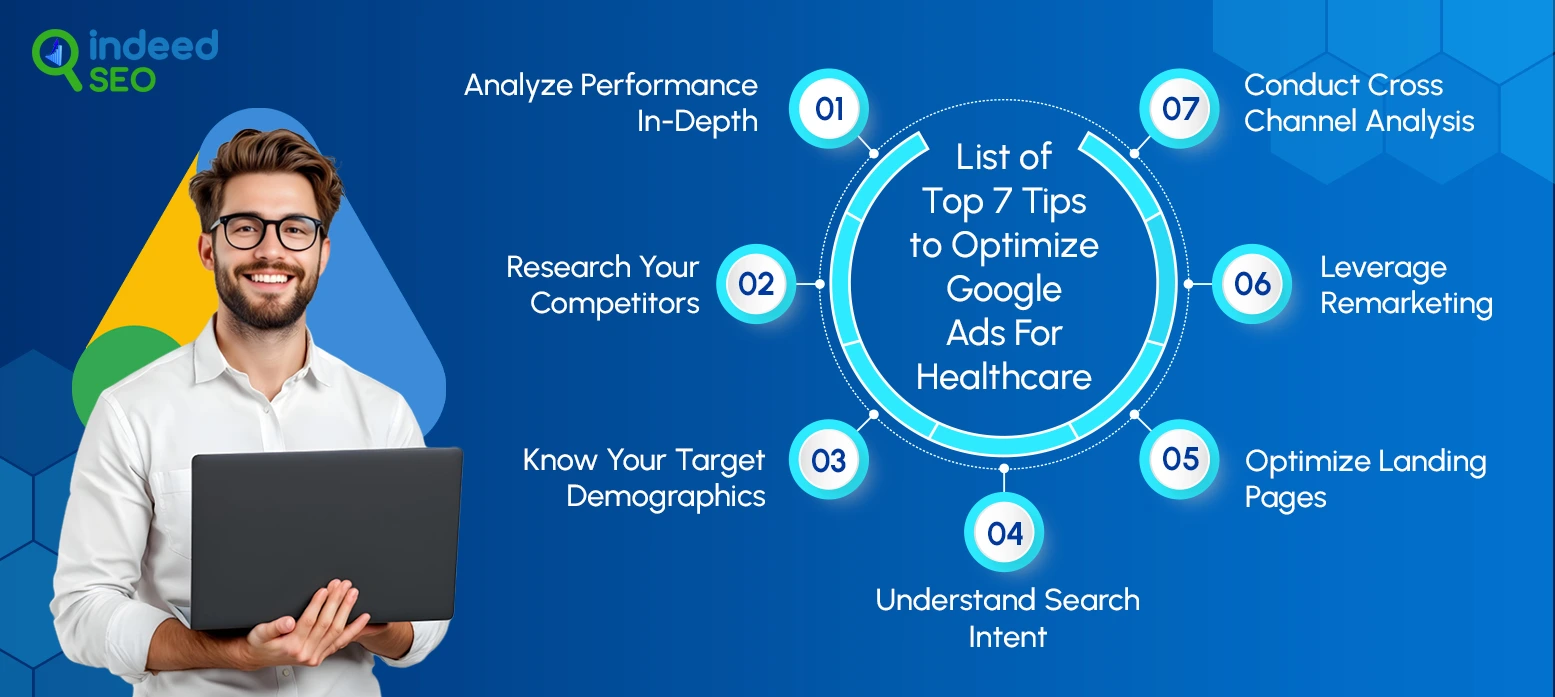
Follow the following healthcare Google Ads optimization tips to drive high-quality impressions, turn clicks into conversions, and enhance your online presence for long-term success.
-
Analyze Performance In-Depth
The most effective tip for optimizing Google Ads is to evaluate performance metrics. This crucial step will help you identify which aspects of the campaign require attention. The first step towards accurately assessing campaign performance is implementing conversion tracking. Some campaigns may require tracking multiple conversion actions, as relying on a singular view may not provide a complete perspective.
You can monitor user interactions, not just purchases made immediately after clicking the ad. Your Google Ads account permits the creation of up to 15 trackable user actions, such as subscribing to a newsletter, downloading an eBook, or submitting contact details. After setting up conversion tracking and allowing your ad campaigns to run for a sufficient duration, you need to interpret all that data.
-
Research Your Competitors
Performing a competitive pay-per-click analysis is a crucial strategic step for crafting a successful advertising campaign in the healthcare sector. This analysis offers a detailed overview of the pay-per-click environment related to your products or services, unveiling essential insights into keyword utilization and messaging strategies.
These insights can significantly enhance your targeting and bidding approaches. Conducting a thorough competitive analysis provides valuable tools to optimize your paid search advertisements and gain an edge.
-
Know Your Target Demographics
The next tip to optimize Google Ads for Healthcare is to know your target demographics. To effectively curate the audience for your advertisements, it is essential to focus on specific keywords that align with your niche. Additionally, selecting the appropriate demographic is crucial.
While many businesses have a general understanding of their target audience, designing campaigns that appeal directly to these specific demographics is vital to encourage conversions. Instead of relying solely on assumptions, it is advisable to customize demographic targeting based on actual performance data. By running reports on which demographics yield the highest conversion rates across various campaigns, businesses can make informed decisions and optimize their targeting strategies for better results.
-
Understand Search Intent
Optimizing Google Ads for the healthcare industry requires thoroughly understanding search intent. This understanding is crucial for selecting the most relevant keywords to engage qualified audiences. Choosing the appropriate keywords is vital, as they determine how your ads are displayed in response to relevant search queries.
To maximize effectiveness, it’s vital to ensure that your ads and their respective landing pages align with your audience’s various queries, including informational, commercial, navigational, and transactional searches. This alignment helps to enhance the relevance and performance of your advertising campaigns.
-
Optimize Landing Pages
Landing pages serve a specific purpose in advertising, particularly within healthcare PPC campaigns. These pages should be optimized to maximize effectiveness with a clear Call to Action (CTA) that encourages the target audience to engage and convert.
When landing pages are tailored to align with the overarching advertising campaign, they can significantly boost the number of clicks that lead to conversions. This, in turn, enhances the return on investment (ROI) for your PPC efforts, making it crucial to focus on optimizing these pages.
-
Leverage Remarketing
If someone shows interest in your product or service, give them extra attention. They might need a reminder or a little push to become your customers. Consider running remarketing campaigns targeting the audience who visited your landing page but didn’t convert.
Remarketing Lists for Search Ads (RLSA) is a very effective tool. This method lets you reach people who searched for similar products on Google, saw your ad, and visited your website. It’s a great chance to connect with those already interested in your offer. You can tailor your messages to address their needs and concerns.
-
Conduct Cross-channel Analysis
One important aspect of optimizing Google Ads is assessing your campaign’s performance across various pay-per-click (PPC) channels. A campaign may perform poorly on Google Ads while achieving outstanding results on another platform.
In such situations, adjusting your budget allocation between the different channels based on their performance would be beneficial. To gain this insight, an overview encompassing all your PPC channels is essential. An automated cross-channel dashboard can facilitate this process, allowing for better decision-making and optimized budget distribution.
Conclusion
Still figuring out how to attract the target audience from Google Ads? That’s where IndeedSEO can assist. With years of experience in healthcare PPC and performance-driven tactics, we know how to optimize campaigns for greater exposure, reduced costs, and higher-quality leads. If you want to enhance conversions or expand patient acquisition, IndeedSEO helps you convert data into results and establish a better patient pipeline.