+1 (917) 565-8527

 info@indeedseo.com


Imagine two bakeries on the same street. Both have spotless windows and a great menu. One has a line out the door every morning. The other is quiet.
The difference usually isn’t what’s in the window. It’s what people say about the bakery when they’re not standing in front of it: the food blogger who raved about it, the neighbor who tells everyone, the local paper that ran a feature.
Search engines work the same way. Everything on your own website is your window display. Off-page SEO is everything else: the links, mentions, reviews, and conversations that tell Google (and increasingly, AI tools) that your business is worth recommending.
This guide explains what off-page SEO is, which tactics still work in 2027, which ones to avoid, and how to turn it into a plan you can actually run.
A quick note: IndeedSEO sells off-page services, so we have a stake in this topic. We’ve tried to give you advice you could follow on your own, and we explain at the end where we fit.
Off-page SEO in plain English
Off-page SEO covers every action and signal that happens away from your website but affects how it ranks. The biggest ones are:
- Backlinks: other websites linking to yours.
- Brand mentions: people and publications talking about your business, with or without a link.
- Reviews and local signals: Google Business Profile reviews, directory accuracy, ratings.
- Community and social presence: useful participation on forums, social platforms and video.
- Digital PR: earning coverage in news, trade media and industry publications.
You’ll also see it called off-site SEO, off-page optimization or offpage SEO. They all mean the same thing.
On-page vs off-page SEO at a glance
| On-page SEO | Off-page SEO | |
|---|---|---|
| Where it happens | On your website | Everywhere else |
| You control it | Fully | Partly (you earn it) |
| Examples | Titles, headings, content, internal links, page speed | Backlinks, mentions, reviews, PR |
| Speed | Faster to change | Slower to build |
| Main job | Help search engines understand your page | Show that others trust your page |
| Risk | Low | Higher if you take shortcuts |
You need both. A strong site nobody mentions struggles to rank, and a heavily linked site with weak pages wastes the attention. Our guide to on-page optimization covers the other half.
Why off-page signals still matter in 2027

Search engines can’t judge a business just by reading its own website, because every site says it’s the best. So they look for outside evidence, and links have long been one of the signals they use.
The data points in the same direction. Backlinko’s analysis of 11.8 million Google results found that the number-one result has about 3.8 times as many backlinks as the results in positions two through ten. That’s a correlation, not proof that links alone cause rankings, and Backlinko says so itself. But it fits what most SEOs see in practice: top pages usually have strong outside support.
And the rules are shifting beyond Google’s blue links. An Ahrefs study of 75,000 brands found that how often a brand is mentioned across the web correlated with its visibility in Google’s AI Overviews far more strongly (0.664) than backlinks did (0.218). Again, that’s correlation, but it suggests a lesson: being talked about matters as much as being linked to.
The signals worth building
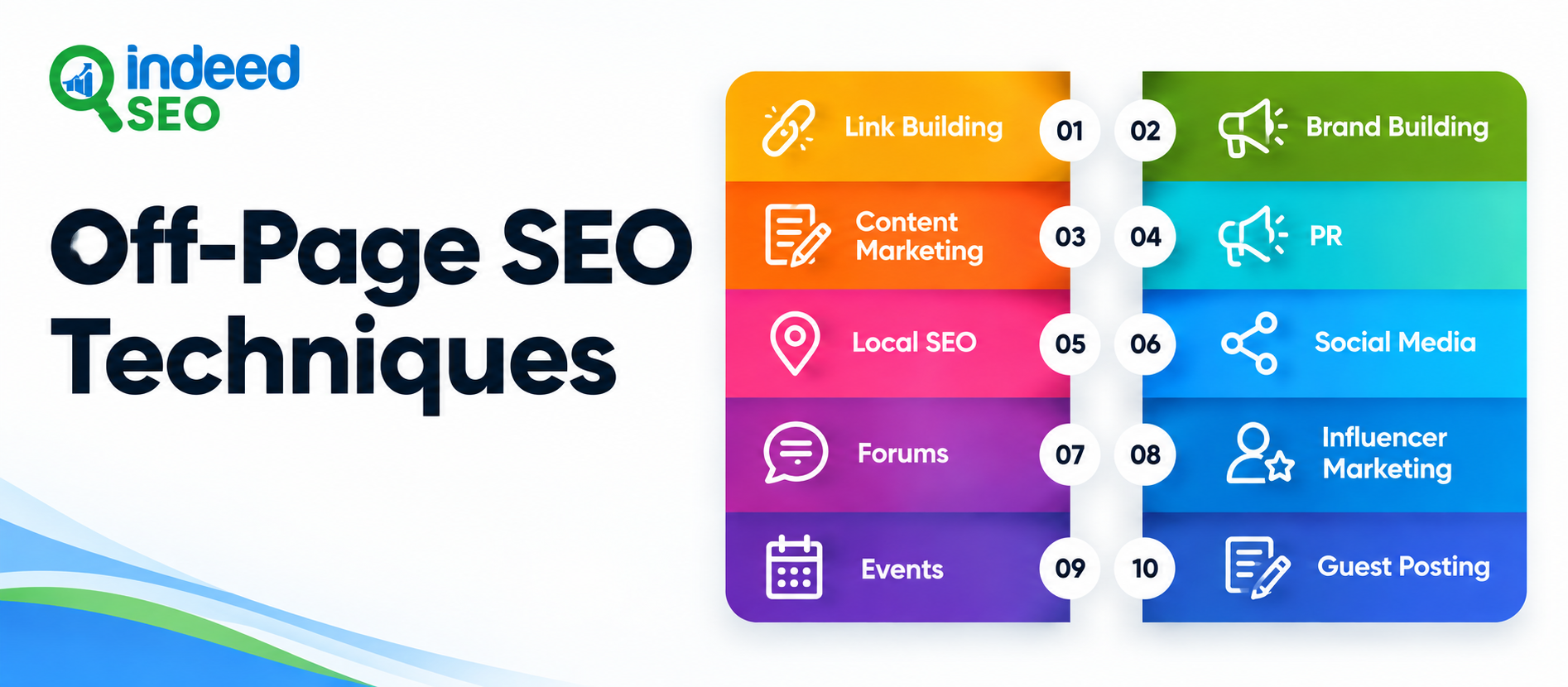
Quality over quantity in backlinks. One link from a respected, relevant site is worth far more than dozens from random ones. Relevance matters: a link to your plumbing site from a home-improvement publication beats a link from an unrelated blog.
Diverse sources and natural anchors. A healthy profile has links from many different sites, with anchor text that looks natural (your brand name, the page’s topic, a plain “click here”), not the same keyword repeated.
Brand mentions. Unlinked mentions still count as evidence that people know you. Tracking them (and politely asking for a link where it makes sense) is one of the cheapest wins in SEO.
Reviews and local trust. For local businesses, reviews and an accurate Google Business Profile are off-page signals too. See local SEO services for how they fit together.
Real engagement. Genuine participation in the places your customers spend time, from industry forums to video platforms, builds recognition and referral traffic.
Link types and attributes, explained
Not every link passes the same signal, and Google gives specific guidance on how to label them in its documentation on qualifying outbound links.
| Link type | What it means | When it’s used |
|---|---|---|
| Followed (default) | A normal editorial link | A site links to you because it chose to |
| rel=”nofollow” | “Don’t associate us with this page” | When no other value fits |
| rel=”sponsored” | A paid or sponsored link | Ads, sponsorships, paid placements |
| rel=”ugc” | User-generated content | Comments, forum posts |
Google says links marked this way will “generally not be followed,” so they aren’t guaranteed instructions, but they’re the right way to label paid and user-generated links. Nofollow links aren’t worthless: they can still send real visitors and build awareness.
Off-page tactics that work

Think of these as ways to earn attention, not to manufacture it.
1. Digital PR. Create something journalists want to cite: original data, a useful survey, a strong expert opinion. Then pitch it to reporters and trade publications. Coverage brings both links and mentions.
2. Original research and link-worthy content. Studies, benchmarks and clear explainers get cited because other writers need a source. A single well-made resource can earn links for years. Good SEO content writing starts with asking “who would link to this?”
3. Resource and partner links. Find pages that list tools, guides or suppliers in your field and suggest yours where it genuinely fits. Partnerships, sponsorships and supplier relationships can earn links too, labeled correctly if money changes hands.
4. Broken-link and unlinked-mention outreach. If a site links to a dead page on a topic you cover, you can suggest your page as a replacement. If someone mentions your brand without linking, a short, friendly note often fixes it.
5. Expert contributions. Answer journalist requests, appear on podcasts, speak at events and write useful pieces for relevant publications. Editorial guest contributions are fine when the content is genuinely useful and not mass-produced for links. Our link building services page shows how to approach this properly.
6. Reviews and Google Business Profile. Ask happy customers for reviews, answer all of them, and keep your profile accurate. For a local business, this is often the highest-return off-page work.
7. Community and video. Be useful on the forums, communities and video platforms your customers use. Answer questions, share expertise, and link only where it genuinely helps. A helpful presence earns recognition; a drive-by link earns a ban.
8. Events and sponsorships. Local sponsorships, industry conferences and webinars often come with a link, a mention and real-world visibility.
Off-page tactics to skip
Google’s link spam policy lists the patterns that can hurt you. Among the examples it names:
- Buying or selling links for ranking purposes.
- Excessive link exchanges and partner pages built only for cross-linking.
- Automated programs that create links.
- Large-scale guest posting, article marketing or press releases with keyword-rich anchor text.
- Low-quality directory or bookmark links.
- Forum comments with optimized links.
- Keyword-rich links in widgets, footers or templates.
- Low-value content created mainly to manipulate links and rankings.
Google also notes that paid links are not a violation when properly marked with rel=”sponsored”or rel=”nofollow”. So advertising and sponsorships are fine. Buying links to pass ranking credit is not.
Two older habits to retire: dropping your link in forum signatures or blog comments, and submitting to long lists of directories and bookmarking sites. Both are listed as spam examples, and they rarely earn anything useful.
A 90-day off-page checklist
Month 1: audit and foundations
- Review your current backlinks and top-linking domains, and note competitors’ best links.
- Fix technical problems that waste link value, such as broken pages and redirects (a technical SEO audit helps).
- Claim and complete your Google Business Profile and key listings, with consistent name, address and phone.
- Set up tracking for brand mentions.
- Pick two or three assets worth promoting.
Month 2: create and pitch
- Publish one piece of original, link-worthy content (research, a guide or a tool).
- Build a list of 30–50 relevant journalists, bloggers and sites.
- Send personalized pitches, not templates, and track replies.
- Start a review request routine with customers.
- Reach out to sites that mention you without linking.
Month 3: expand and measure
- Follow up on pitches and pursue two or three partnerships or sponsorships.
- Contribute expert comments, podcast guests or event talks.
- Review which tactics earned links, mentions and traffic, and do more of those.
- Check for any suspicious links (see below) and document your findings.
- Plan the next quarter based on what worked.
How to measure off-page results
Don’t count links; count the effect. Track:
- Referring domains: the number of different sites linking to you, with attention to relevance and quality.
- Brand mentions and branded searches: growth over time is a sign that awareness is building.
- Referral traffic: real visitors from the sites linking to you.
- Rankings and organic traffic: for the pages you’ve promoted.
- Leads and revenue: the number that matters most.
Free tools like Google Search Console show who links to you, and paid tools like Semrush and Ahrefs go deeper. Expect results to take months, not days: Ahrefs’ research found that most new pages don’t reach the top 10 within a year, and low-competition keywords move much faster than high-volume ones.
Cleaning up bad links (and when not to)
A few spammy links pointing at your site are normal, and Google says it can usually work out which links to trust. According to its disavow tool documentation, “most sites will not need to use this tool,” and it should be used only if you have a manual action for unnatural links or expect one because of paid or spammy link schemes. Google also advises trying to get the bad links removed first, and warns that the tool can hurt your performance if used incorrectly.
So the rule of thumb: don’t disavow out of anxiety. Disavow only after you’ve found a real pattern of manipulative links, and ideally with expert help.
Off-page SEO and AI search
When someone asks ChatGPT, Gemini or Google’s AI Overviews to recommend a provider, the answer draws on what the web says about that business. That’s why mentions matter. To strengthen the signal:
- Be consistently described. Use the same business name, description and details across your site, profiles and directories.
- Earn coverage in credible places. Trade publications, local media and industry sites carry weight.
- Publish clear, citable content, with data and well-structured answers, so others have a reason to reference you.
- Keep reviews current on the platforms your customers use.
If you want to go deeper on this side, see our overview of AEO services.
Off-page SEO by business type
Local businesses: reviews, Google Business Profile, local press and community sponsorships usually matter most.
Ecommerce: product-focused PR, reviews on trusted platforms, creator and affiliate partnerships, and links to useful buying guides. Our e-commerce SEO page goes into specifics.
B2B and software: research and data studies, partner integrations, industry podcasts and expert commentary.
Professional services: thought leadership, speaking, case studies with named clients, and directories your clients genuinely use (like legal or medical associations).
Do it yourself or hire help?
You can do plenty on your own: claiming profiles, asking for reviews, publishing useful content and pitching a handful of relevant sites. Hiring help makes sense when you lack the time for outreach, need relationships with publishers, or want a plan and reporting you can trust.
If you do hire, ask what exactly you’ll get each month, how links are earned, which sites they target and why, what reports you’ll see, and what happens if you leave. Be cautious of promises of a fixed number of links per month, guaranteed rankings, or links priced per placement with no detail on where they go.
Where IndeedSEO fits
Since this is our guide, here’s what our own page says we do. IndeedSEO’s off-page optimization service covers digital PR and link building, resource link building, broken-link building, content and guest contributions, community engagement and influencer outreach, plus brand-mention monitoring and competitor backlink analysis.
How it works: a free 30-minute call, an off-site audit or strategy workshop, a customized proposal, and a quarterly plan reviewed after three months. Our site says quality is preferred over quantity. We don’t publish prices, and we don’t guarantee rankings. You can see how our work performs in our case studies.
Ready to build your off-page plan?
Start small: audit what you have, pick one asset worth promoting and pitch it to ten relevant sites. If you’d like help turning that into a plan, request a quote from IndeedSEO or get in touch.
Common questions about off-page SEO
What is off-page SEO?
Off-page SEO is everything that happens outside your website that affects how it ranks: backlinks, brand mentions, reviews, PR and community activity.
What does off-page SEO include?
Mainly backlinks, brand mentions, digital PR, reviews and local signals, social and community participation, and partnerships or sponsorships.
How do I improve off-page SEO?
Create content others want to cite, pitch it to relevant sites and journalists, earn reviews, reclaim unlinked mentions and take part in your industry’s communities. Avoid buying links or mass-producing them.
How do I do off-page SEO step by step?
Audit your current links and mentions, fix technical issues, build your profiles, publish one strong asset, pitch it to relevant sites, then measure and repeat. The 90-day checklist above lays this out.
What’s the difference between on-page and off-page SEO?
On-page SEO covers what’s on your site: content, titles, structure and speed. Off-page SEO covers what others do and say about you elsewhere. Both matter.
How does off-page SEO affect rankings?
Links and mentions act as outside evidence of trust and relevance. Studies show strong correlations between backlinks and rankings, though correlation doesn’t prove cause.
Do nofollow links help?
They don’t pass credit in the same way, but they can still bring visitors and build awareness. Paid links should carry rel=”sponsored”or rel=”nofollow”.
Are directories and bookmarking sites still worth it?
Low-quality directory and bookmark links are named as spam examples in Google’s policy, so they’re best avoided. Directories your customers genuinely use are different.
Is off-page SEO still effective in 2027?
Yes, with a shift in focus: earning mentions, coverage and reviews matters more than collecting links, and those same signals feed AI-generated answers.
How long does off-page SEO take?
Plan for months. Ahrefs’ research found that most new pages don’t reach the top 10 within a year, and competitive terms take longer than low-competition ones.
Should I hire an off-page SEO expert?
If you lack time or publisher relationships, yes. Ask for a clear scope, a sample report and an explanation of how links are earned, and avoid anyone promising guaranteed rankings or a fixed number of links.