+1 (917) 565-8527

 info@indeedseo.com

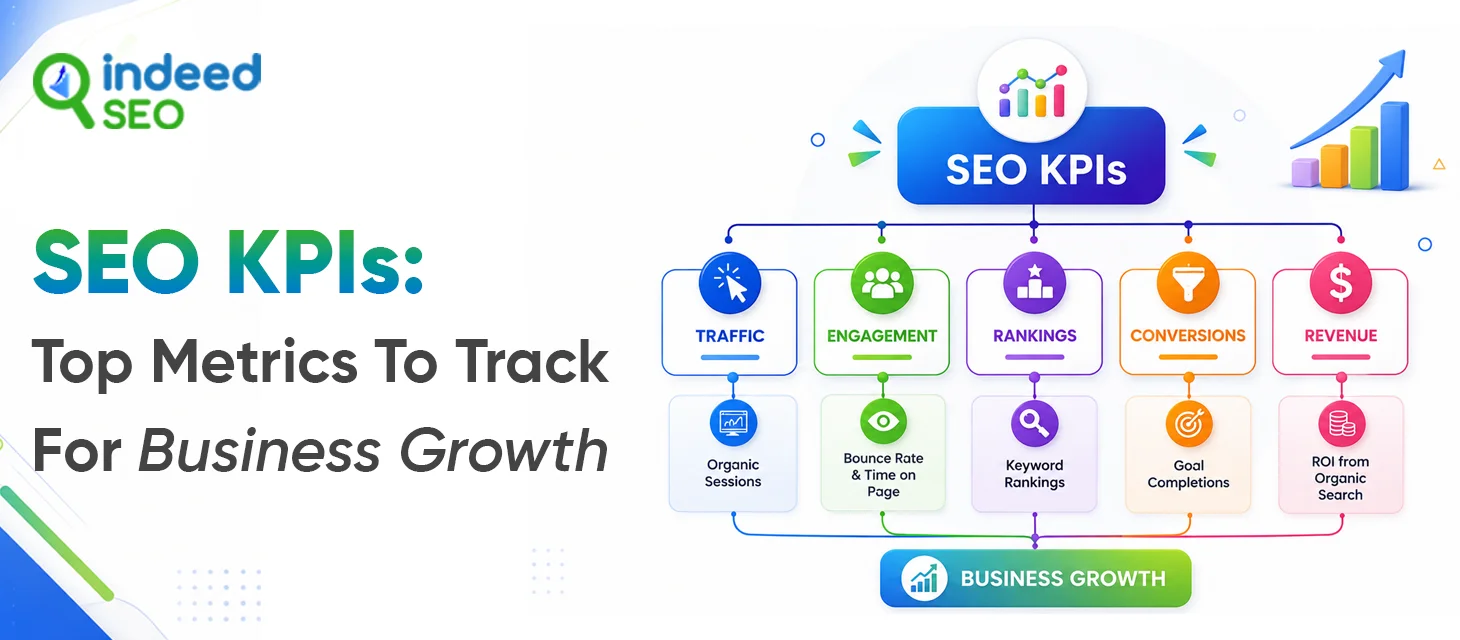
To measure business growth, professional SEO agencies track core SEO KPIs that directly link search performance to revenue. These core SEO metrics are important Key Performance Indicators (KPIs) to measure business growth, offering insights into conversion rate, organic traffic, click-through rate (CTR), engagement rate, Core Web Vitals, and keyword rankings/share of voice.
Professional SEO agencies like IndeedSEO help businesses understand and measure these metrics. SEO KPIs help brands measure what’s working, uncover areas for improvement, and make the right optimizations to align with user intent and drive better business results.
In this blog, let’s understand these SEO KPIs to track business growth efficiently.
Build a Performance-Driven SEO Strategy with IndeedSEO
What are SEO KPIs and why are they important?
SEO KPIs, or Search Engine Optimization Key Performance Indicators, are metrics used to track search engine performance. These KPIs help measure market visibility, digital traffic, incoming leads, and overall business earnings.
SEO KPIs are important because they help businesses:
- Measure SEO performance
- Track business results such as leads, sales, and revenue
- Identify SEO problems and performance gaps
- Improve decision-making to invest in accurate resources
- Measure ROI
Traffic and Visibility KPIs
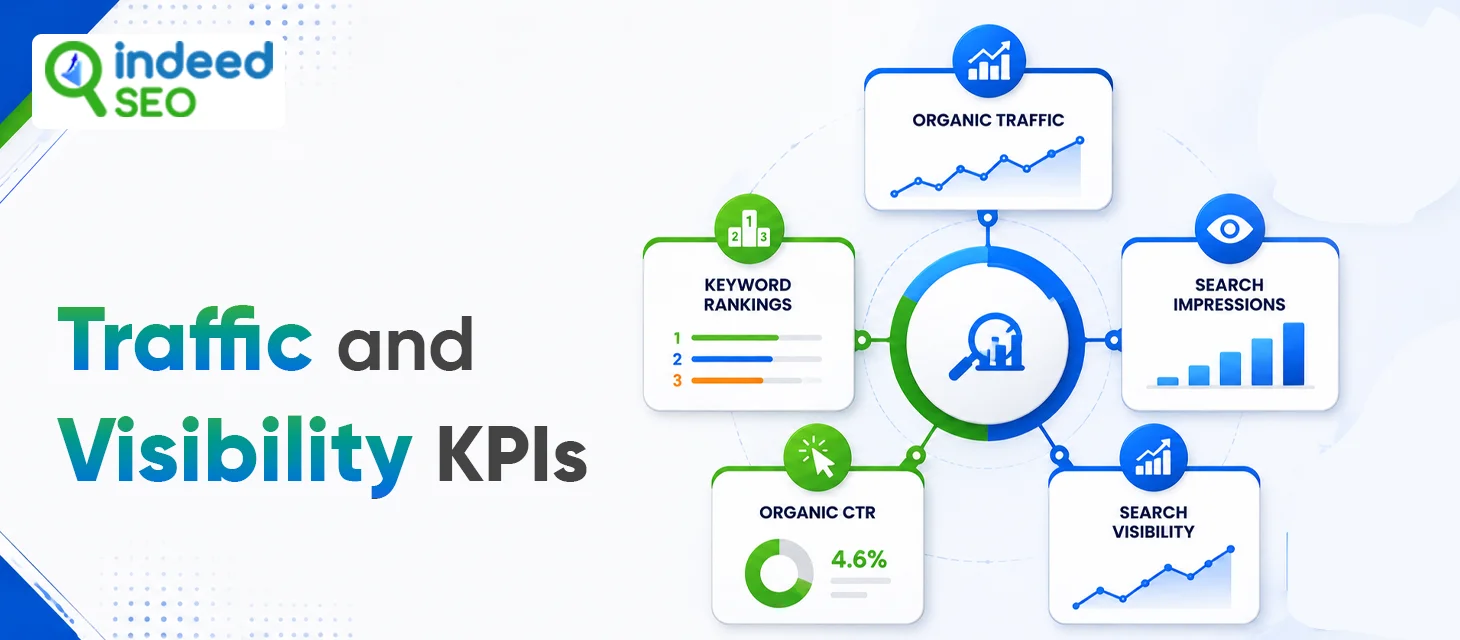
Traffic and visibility KPIs show how effectively your website is appearing in search results and attracting unpaid or organic visitors. These metrics are useful for measuring organic reach, keyword performance, and the quality of your search presence.
1. Organic Traffic
Organic traffic is the number of visitors who reach your website following unpaid search results.
It is one of the first metrics businesses use to measure their SEO performance. However, total traffic does not inform about business growth.
Look at organic traffic with respect to:
- Landing pages
- Search queries
- Locations
- Devices
- New and returning users
- Engagement
- Conversions
A rise in traffic is valuable when those visitors are relevant to your business.
2. Keyword Rankings
Keyword rankings show where your targeted webpages and keywords appear for specific search queries.
Tracking important keywords helps you identify your individual page performance. It can also reveal opportunities to rank optimized pages to the first page of search results.
A generic keyword can have high search volume but little commercial value. This is why businesses should target keywords that generate fewer searches but bring highly qualified customers.
Focus on keywords based on:
- Search intent
- Relevance
- Competition
- Business value
- Conversion potential
3. Search Impressions
Search impressions show how often your website appears in search results. An increase in search impressions can indicate more mentions in search queries.
Track impressions alongside:
- Impressions
- Clicks
- CTR
- Average Position
4. Organic CTR
Organic click-through rate measures how often people click your search result after seeing it. Even a high-ranking page can have less CTR, which reduces its effect and performance. Common reasons include:
- Weak title tags
- Poorly matched search intent
- Unclear page descriptions
- Strong competitor results
- SERP features
- Low brand recognition
The basic formula to calculate CTR: Organic CTR = Clicks ÷ Impressions × 100
Improve CTR by writing clear, relevant titles and descriptions for users to read. A high CTR is only useful when the resulting visitors find what they expected.
5. Search Visibility
Search visibility helps a business understand how its overall website appears across relevant searches. This is particularly useful for larger websites with a high number of targeted keywords.
Monitor changes over time and segment visibility by:
- Product category
- Service
- Location
- Search intent
- Device
- Topic
User Experience and Technical KPIs
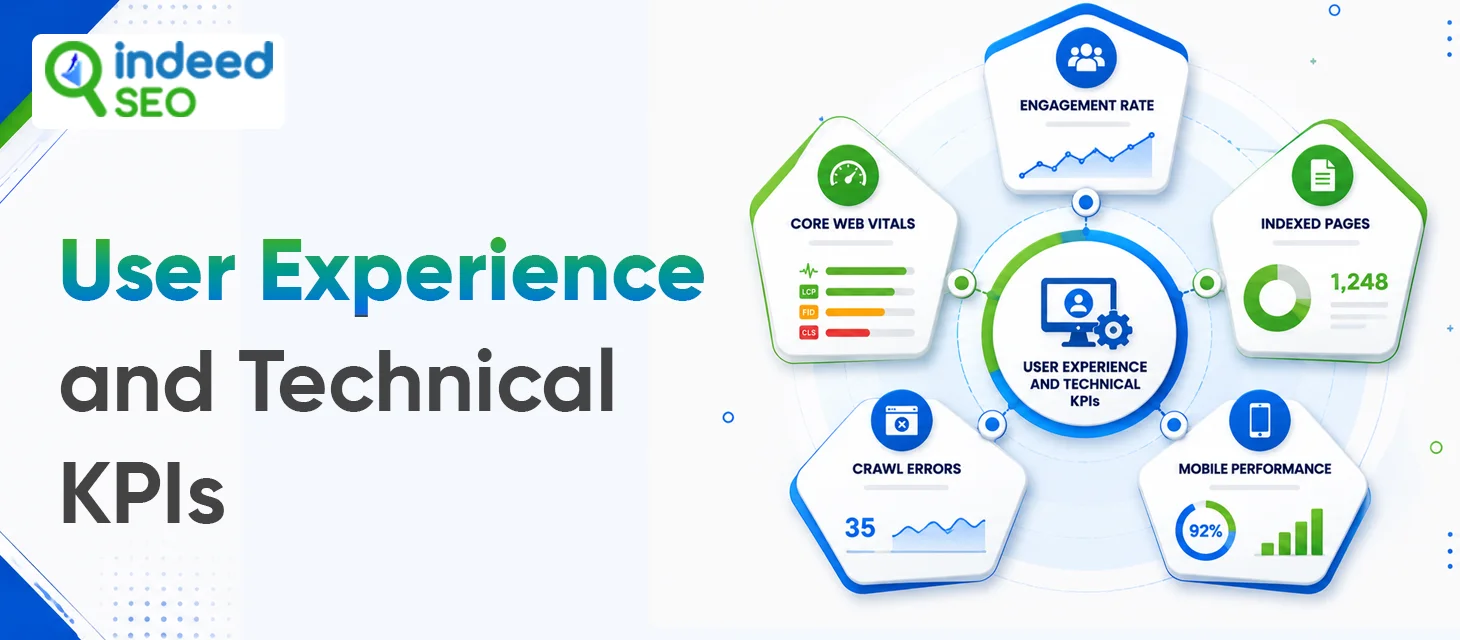
Your website should provide a great user experience and keep working for search engines. This results in better user conversions and enhanced search engine visibility for both visitors and crawlers. Technical KPIs help find errors that can hurt crawling and indexing to increase website performance and visibility.
1. Engagement Rate
Engagement rate measures how actively visitors interact with your website. It helps to understand optimization that can improve page engagement. Brands can use engagement data to understand how visitors respond to different web pages and which pages get the best responses.
Check for:
- Engagement rate
- Engaged sessions
- Average engagement time
- Key events
- Landing page performance
Don’t assume that every short session is ineffective. A visitor who lands on a contact page and immediately converts is also a success for your business profitability.
2. Core Web Vitals
Core Web Vitals measure important aspects of the user experience.
The current Core Web Vitals include:
- Largest Contentful Paint: Measures loading performance.
- Interaction to Next Paint: Measures responsiveness.
- Cumulative Layout Shift: Measures visual stability.
A website that loads slowly can reduce user engagement and browsing experience. Brands can monitor Core Web Vitals using technical SEO tools like Google Search Console and PageSpeed Insights.
3. Indexed Pages
Indexed pages are webpages that search engines have added to their index and can potentially show in search results. This KPI becomes especially important for large websites.
Monitor:
- Valid indexed pages
- Excluded pages
- Crawled but not indexed pages
- Duplicate pages
- Canonical issues
- Important pages missing from the index
More indexed pages do not automatically mean more traffic. The goal is to ensure that your important pages are easily discovered and read.
4. Crawl Errors
Crawl errors occur when search engines encounter issues accessing the webpages.
Common examples include:
- 404 errors
- Server errors
- Broken links
- Redirect problems
- Blocked resources
- Incorrect robots.txt rules
Always monitor your website for technical problems, mainly after updates or migrations. Resolve high-priority errors like broken links and expired URLs to gain quality traffic and results.
5. Mobile Performance
A large share of web searches happen on mobile devices, making mobile performance an important part of website optimization.
Check whether your website:
- Loads quickly on mobile
- Uses responsive design
- Has readable text
- Provides easy navigation
- Uses appropriately sized buttons
- Avoids intrusive elements
- Works properly across different screen sizes
Test important pages rather than checking only the homepage.
Product pages, service pages, forms, checkout pages, and contact pages all deserve attention.
Revenue and Outcome KPIs
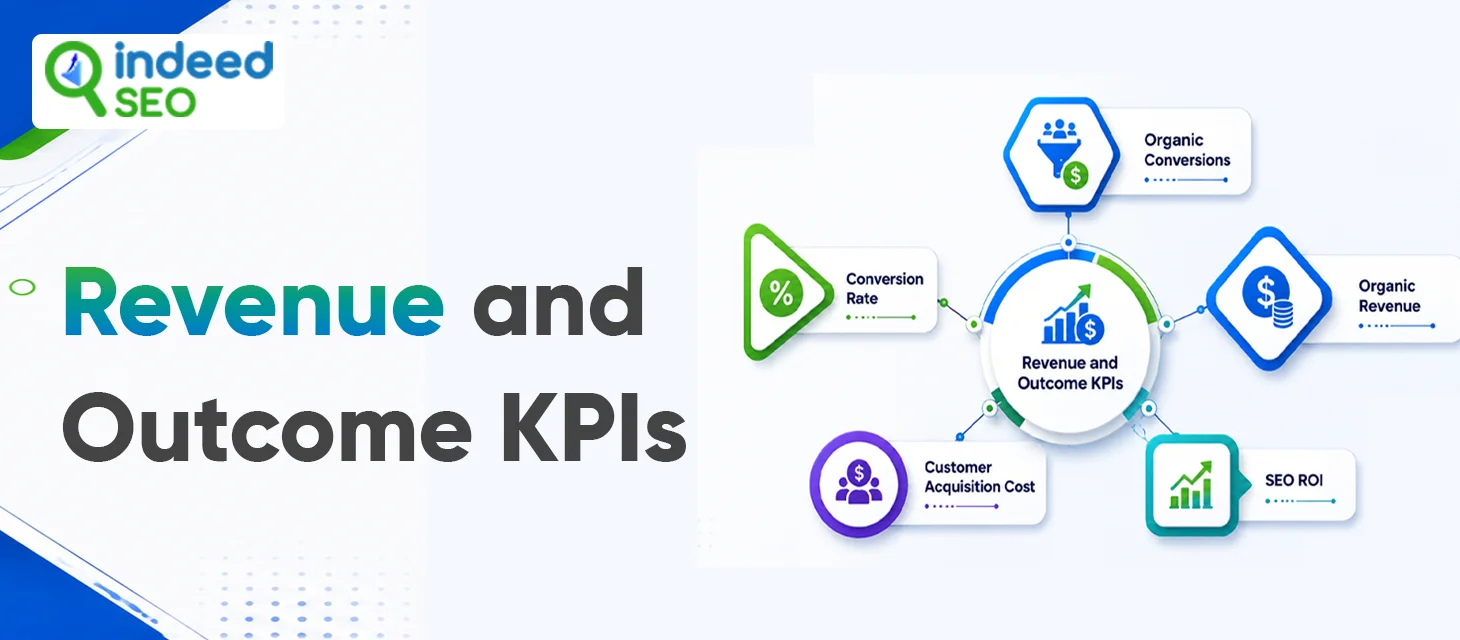
Revenue and outcome KPIs help a brand understand their performance results and visibility contribution in business growth. For most businesses, these are the metrics that matter most when evaluating SEO investment.
1. Organic Conversions
Organic conversions measure valuable website actions completed by visitors. Depending on the business, conversion metrics can include:
- Purchases
- Lead forms
- Phone calls
- Demo requests
- Quote requests
- Account registrations
- Appointment bookings
- Newsletter signups
Perform brand analysis using an analytics platform to identify which organic landing pages generate most conversions.
2. Conversion Rate
Organic conversion rate shows the percentage of organic visitors who complete an action.
The formula is:
Conversion Rate = Conversions ÷ Organic Visitors × 100
A low conversion rate does not mean weak SEO. The issue may be the audience and search intent targeting, which reduces conversions.
Improve conversion rates by:
- Matching content with search intent
- Strengthening calls to action
- Improving page experience
- Simplifying forms
- Adding trust signals
- Making contact options easy to find
3. Organic Revenue
Organic revenue counts the profits earned from searchers who find you entirely without ads. For retail sites, this looks fairly easy since sales get tracked instantly. For corporate firms, calculation proves quite difficult because digital shoppers usually use distinct media platforms before making an official purchase.
Track organic revenue alongside:
- Transactions
- Average order value
- Lead value
- Assisted conversions
- Customer lifetime value
Avoid assigning all budgets to a single marketing strategy. It is important to use several marketing channels for targeted optimization and the most effective results.
4. Customer Acquisition Cost
Customer acquisition cost, or CAC, measures how much it costs to acquire a customer.
For SEO, consider costs such as:
- SEO agency fees
- SEO tools
- Content production
- Technical development
- Internal SEO staff
- Digital PR and link acquisition
A simple calculation is:
CAC = Total SEO Investment ÷ Customers Acquired Through SEO
For example, if a company spends $20,000 on SEO and gains 100 customers:
$20,000 ÷ 100
CAC = $200 per customer
5. SEO ROI
SEO ROI measures the financial return generated from your SEO investment.
A basic formula is:
SEO ROI = (SEO Revenue − SEO Investment) ÷ SEO Investment × 100
For example, if SEO generates $50,000 in revenue from a $20,000 investment:
($50,000 − $20,000) ÷ $20,000 × 100
ROI = 150% ROI
Build a Performance-Driven SEO Strategy with IndeedSEO
Conclusion
Want to track your core SEO KPIs to analyze your business performance?
IndeedSEO helps businesses strengthen organic visibility while focusing on qualified traffic, leads, conversions, and revenue. Our tailored approach helps brands build SEO strategies around their goals, track performance through meaningful KPIs, and gain clear insights to support growth.