+1 808 999 0096

 info@indeedseo.com
Outsourcing the cheapest SEO service is always the most expensive mistake. That’s because businesses that outsource SEO purely on price often end up paying twice – once for months of low-cost “optimization,” and again to undo the damage after a ranking collapse, a Google penalty, or a site that never recovers its previous traffic. The pattern is simple: quick results at first, but bigger problems later.
The real issue isn’t outsourcing to India- it’s choosing providers that rely on shortcuts to offer unrealistically low prices. Effective SEO requires thorough keyword research, technical optimization, high-quality content, and ethical link building, all of which take time, expertise, and ongoing effort. This is exactly what a $150/month retainer can’t include.
This guide breaks down exactly why cheap SEO outsourcing backfires, the red flags that signal it before you sign, and what a legitimate outsourcing partnership looks like- so you can invest with confidence instead of finding out the hard way.
Choose IndeedSEO a Trusted SEO Company in India for Long-Term Success
What Does “Cheap SEO Outsourcing” Actually Mean?
Cheap SEO outsourcing isn’t about outsourcing to a specific country- it’s about paying for services that are priced so low they can’t realistically deliver quality SEO. While outsourcing to countries like India can be cost-effective, extremely cheap SEO packages often rely on shortcuts instead of proven services.
Most cheap SEO packages cost between $100 and $250 per month with the promise of 100% quality results. Ironically, with such a statement, they mean 100% of lies!
At this price point, providers usually can’t invest enough time in research, content creation, technical optimization, or quality link building. Instead, they often use automated tools, generic tactics, or outdated SEO tactics that may deliver short-term gains but rarely support long-term growth.
Common signs of cheap SEO outsourcing include:
- Guaranteed #1 rankings
- Hundreds of backlinks every month
- No SEO audit
- No content strategy
- Extremely low pricing
- Long-term contracts without exit options
- No reporting transparency
- No dedicated SEO manager
- No explanation of SEO methods
A better SEO partner usually costs more upfront, but it provides a customized service, ethical optimization, and measurable long-term progress.
This is a simple overview of typical SEO Outsourcing Cost and What You Can Expect
| Business Size | Monthly Investment | What You Usually Get |
|---|---|---|
| Small Business | $400–$800 | Foundational SEO Service On-page optimization Gradual quality improvements |
| Growing Business | $800–$2,500 | Comprehensive SEO technical optimization content marketing quality link building regular reporting |
| Enterprise | $3,000+ | Enterprise SEO with- Dedicated team Advanced SEO Service Digital PR Ongoing optimization |
Key Reasons Cheap Outsourcing SEO Services in India Always Backfire
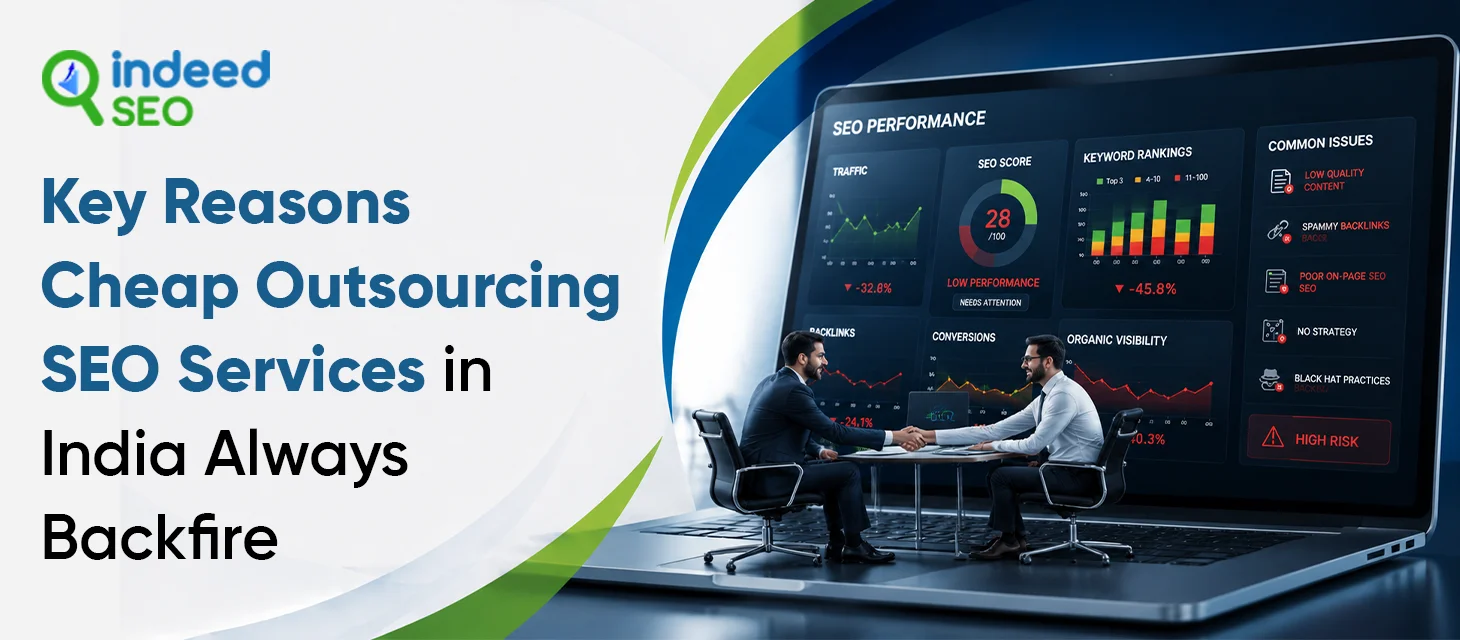
Cheap SEO outsourcing rarely fails quietly- it fails in ways that cost more than doing nothing at all. When SEO work happens remotely, with a provider you rarely see day-to-day, the shortcuts that keep prices low are also the ones hardest to catch until the damage is already done. Here’s where it actually goes wrong.
Unrealistically Low Pricing
Effective SEO involves keyword research, technical optimization, content creation, quality link building, and continuous monitoring. Delivering all of that for $100–$300 a month is rarely realistic- something has to give, and when you’re managing the relationship remotely, you often can’t see what’s being cut.
Low-cost outsourced providers typically:
- Spend far fewer hours on your account than the work requires
- Assign one person to juggle SEO tasks across dozens of clients
- Replace manual work with automation to cover the gap
- Quietly reduce the quality or quantity of deliverables
Why it backfires: You’re paying every month for work you have no practical way to verify from a distance. Most businesses only discover how little was actually done when they bring in a second agency to audit the account- months, and several payments, later.
No Customized SEO Service
A working SEO campaign starts with your business, your competitors, and your actual customers. That takes time per client- time a low-cost provider running dozens of remote accounts at once doesn’t have.
Cheap outsourced providers often:
- Run the same process for every client, regardless of industry
- Skip competitor and market research entirely
- Target generic, high-volume keywords instead of ones your customers actually search
- Optimize for rankings, not for leads or revenue
Why it backfires: Months of budget go toward keywords that were never going to convert. You don’t find this out until you check whether the “wins” in the report actually turned into business- and by then, the budget’s spent.
Overdependence on Automation
AI tools and automation can support SEO work, but they can’t replace judgment. Providers managing high volumes of outsourced clients often lean on automation specifically to make the math work at a low price point.
Common shortcuts:
- AI-generated content with light or no editing
- Fully automated keyword research with no manual review
- Bulk backlink software instead of real outreach
- Template reports that look the same for every client
Why it backfires: This isn’t just lower quality- mass AI-generated content and automated link patterns are exactly what Google’s spam and helpful-content systems are built to detect. A shortcut meant to save money can trigger the kind of visibility loss that takes far longer to undo than to prevent.
Low-Quality Content and Links
Backlinks and content remain real ranking factors, but quality determines whether they help or hurt. Cheap outsourced work optimizes for volume because volume is easier to deliver at scale across many accounts.
This usually shows up as:
- Thin or duplicate content that doesn’t match what people are actually searching for
- Backlinks from irrelevant, low-authority, or spammy websites
- Little real value delivered to either users or search engines
Why it backfires: Bad backlinks aren’t just wasted- they can get your site flagged under Google’s link spam systems. Fixing that means a disavow process and rebuilding trust with Google, which usually costs more time and money than the original “savings.”
Neglected Technical SEO
Technical SEO determines whether search engines can properly crawl, index, and rank your site. It’s also the easiest thing to skip on a budget account, because problems here are invisible unless someone is actively checking.
Budget outsourced packages frequently miss:
- Crawl and indexing errors
- Page speed and Core Web Vitals issues
- Internal linking structure
- Structured data (schema markup)
- Broken links and technical errors
Why it backfires: Because you’re not reviewing the technical side yourself, these issues compound silently in the background. Most businesses only notice once traffic has already dropped- at which point it’s a recovery project, not a maintenance task.
Black-Hat SEO Practices
Some providers chase fast ranking wins because fast wins are what gets a low-cost contract renewed. The tactics that produce them are also the ones most likely to get a site penalized.
Common tactics include:
- Keyword stuffing
- Private Blog Networks (PBNs)
- Doorway pages
- Excessive, unnatural anchor text
- Spammy, high-volume backlink campaigns
Why it backfires: These tactics are easy to hide inside a monthly report you don’t have the SEO expertise to fully audit- until a Google algorithm update wipes out rankings overnight. Sites hit this way often lose more traffic than they ever gained, and recovery can take months.
Lack of Ongoing Optimization
SEO isn’t a one-time setup – it requires ongoing optimization through competitor analysis, aligning with changing algorithms and search behavior shifts. Continuous work is also the first thing to disappear once a low-cost contract locks in and the provider’s attention shifts to acquiring new clients.
Cheap outsourced arrangements often stop delivering on:
- Updating existing content
- Monitoring keyword performance over time
- Ongoing technical fixes
- Adapting the outdated SEO service
Why it backfires: SEO rankings don’t stay the same forever. Without regular monitoring and updates, your website can slowly lose rankings, and you may not notice until competitors start appearing above you in search results.
Tips to Hire the Best SEO Outsourcing Company in India

To protect your business from the risks of cheap SEO outsourcing, follow this checklist to choose the best SEO outsourcing company in India:
1. Ask for Case Studies- But Verify Them Yourself
Almost every guide says “check case studies.” Almost no business actually verifies them, which is exactly why this step fails so often- screenshots and traffic graphs are easy to fabricate or cherry-pick.
What to actually do:
- Ask for the client’s name or website, not just a metric and a chart
- Search that domain yourself in a rank tracker or on Google to confirm the results are real and current
- Ask what the site’s traffic looked like before they started- a graph with no baseline means nothing
Where businesses fail here: They see an impressive-looking case study and stop there, without ever checking if the domain in the screenshot is real, still ranking, or even still their client.
2. Request a Live Audit Before You Sign- Not After
Most providers offer a “free strategy call.” Very few offer an actual, specific audit of your site before you commit. This is one of the biggest gaps between what businesses ask for and what actually protects them.
What a real pre-sale audit should include:
- At least 3-5 specific, named issues on your actual site (not generic SEO talking points)
- A rough explanation of what they’d prioritize first and why
Where businesses fail here: They accept a generic service pitch that could apply to any website, mistake enthusiasm and confidence for actual expertise, and sign before anyone has looked closely at their site.
3. Ask Who Will Actually Work on Your Account
This is the question that matters most for outsourced work specifically, because remote agencies vary enormously in whether you get a dedicated specialist or a rotating pool shared across dozens of clients.
Ask directly:
- Will I have a named point of contact, or a support ticket queue?
- How many other accounts does that person manage?
- Is content/link building done in-house, or subcontracted further out?
Where businesses fail here: They assume “agency” means a stable team, when in practice the account can get reassigned repeatedly or subcontracted to freelancers the agency itself doesn’t fully vet.
4. Get Reporting Tied to Business Results, Not Just Rankings
Every guide says “ask about reporting.” Almost none say what a report should actually contain versus what a weak provider will hand you.
A real report should show:
- Organic traffic and conversion trends, not rankings alone
- Specific work completed that month (not a vague “ongoing optimization”)
- What’s planned next and why
Where businesses fail here: They accept a report full of ranking-position screenshots and call it transparency, without ever asking whether any of it translated into leads, signups, or revenue.
5. Check the Contract for an Exit Clause Before You Check the Price
Businesses spend most of their vetting energy on price and almost none on contract terms- which is backward, since the contract is what determines how much damage a bad hire can do.
What to look for:
- Month-to-month terms, or a clear, reasonable exit clause
- No auto-renewal buried in fine print
- Clear ownership of your content, backlink data, and login credentials if you leave
Where businesses fail here: They get locked into a 12-month contract with a provider that turns out to be underperforming by month three, and have no way out without losing the money already spent.
6. Ask How They Handle a Google Algorithm Update
This question almost never appears in generic hiring guides, but it’s one of the fastest ways to separate real expertise from a templated sales pitch- because the answer is hard to fake.
A credible provider should be able to:
- Name a recent update and explain, in plain terms, what it targeted
- Describe how they audit a site after an update, not just “we monitor rankings”
Where businesses fail here: They never ask this question at all, then are blindsided when an update hits and the provider has no real process for diagnosing or responding to it.
Choose IndeedSEO a Trusted SEO Company in India for Long-Term Success
Conclusion
Want to outsource SEO Services in India that drive long-term growth? At IndeedSEO, we help businesses grow with data-driven, white-hat SEO solutions tailored to goals. From in-depth keyword research and technical SEO to high-quality content and authority link building, our experienced team delivers long-term organic growth that helps your business stay ahead of the competition.