+1 808 999 0096

 info@indeedseo.com

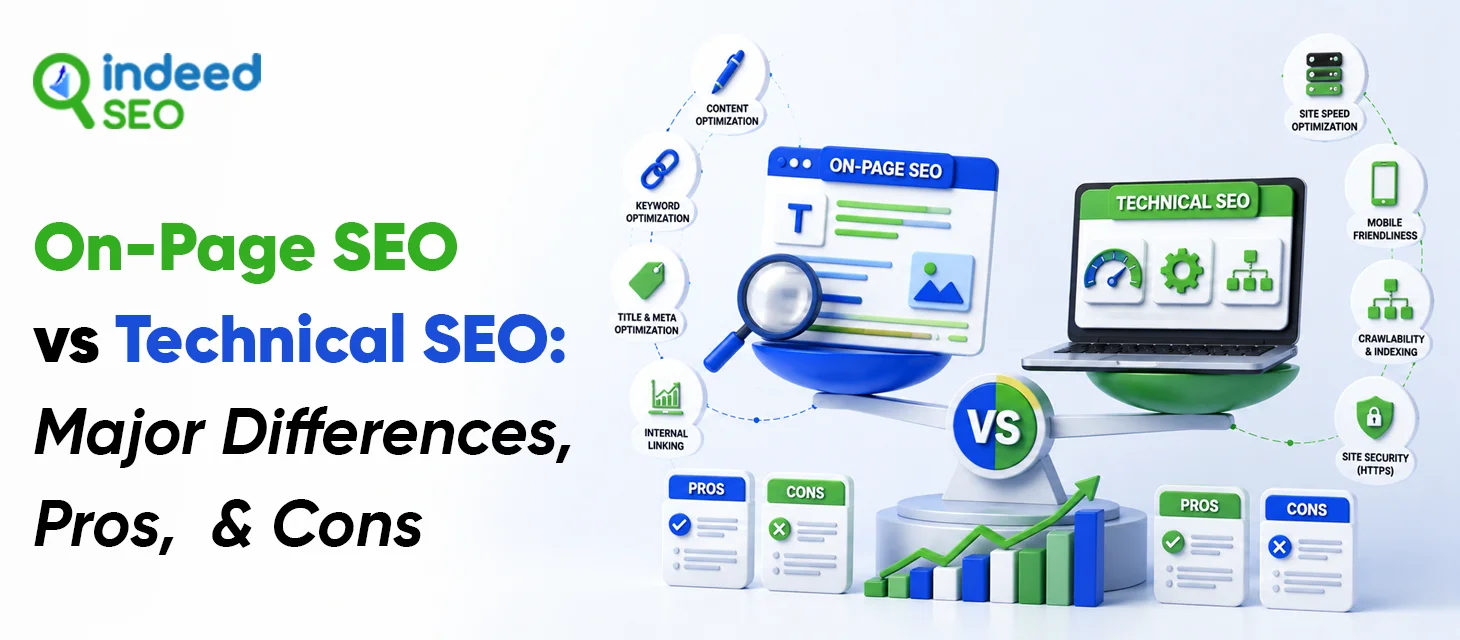
SEO improves your website’s visibility so it can rank higher in organic search results on platforms like Google. But effective SEO goes beyond simply adding keywords to a page. A website requires useful, relevant content and a robust technical infrastructure that enables search engines to crawl, understand, and index its pages.
This is where on-page SEO and technical SEO differ. Whilst on-page SEO relates to factors like content, keywords, titles, and headings, technical SEO is concerned with aspects such as website speed, crawlability, indexation, and site structure.
So what’s the difference between the two? Let’s take a closer look.
Turn SEO Insights Into Higher Search Rankings with IndeedSEO
What Is On-Page SEO?
On-page SEO is the practice of optimizing individual web pages to rank higher and earn more relevant traffic in search engines. It involves tweaking elements directly on your website like:
- Page titles
- Meta descriptions
- Headings
- Keywords and related phrases
- Search intent
- Content quality
- Internal links
- URL structure
- Image optimization
- Overall structure and readability
What Is Technical SEO?
Technical SEO is the process of optimizing a website’s backend infrastructure and code, so search engines and AI systems can easily crawl, render, index, and cite its content. It focuses on the following elements:
- Site speed
- Mobile usability
- Crawlability
- Indexing
- XML sitemaps
- Robots.txt
- Canonical tags
- Redirects
- Broken links
- HTTPS
- Site architecture
- Structured data
- Core Web Vitals
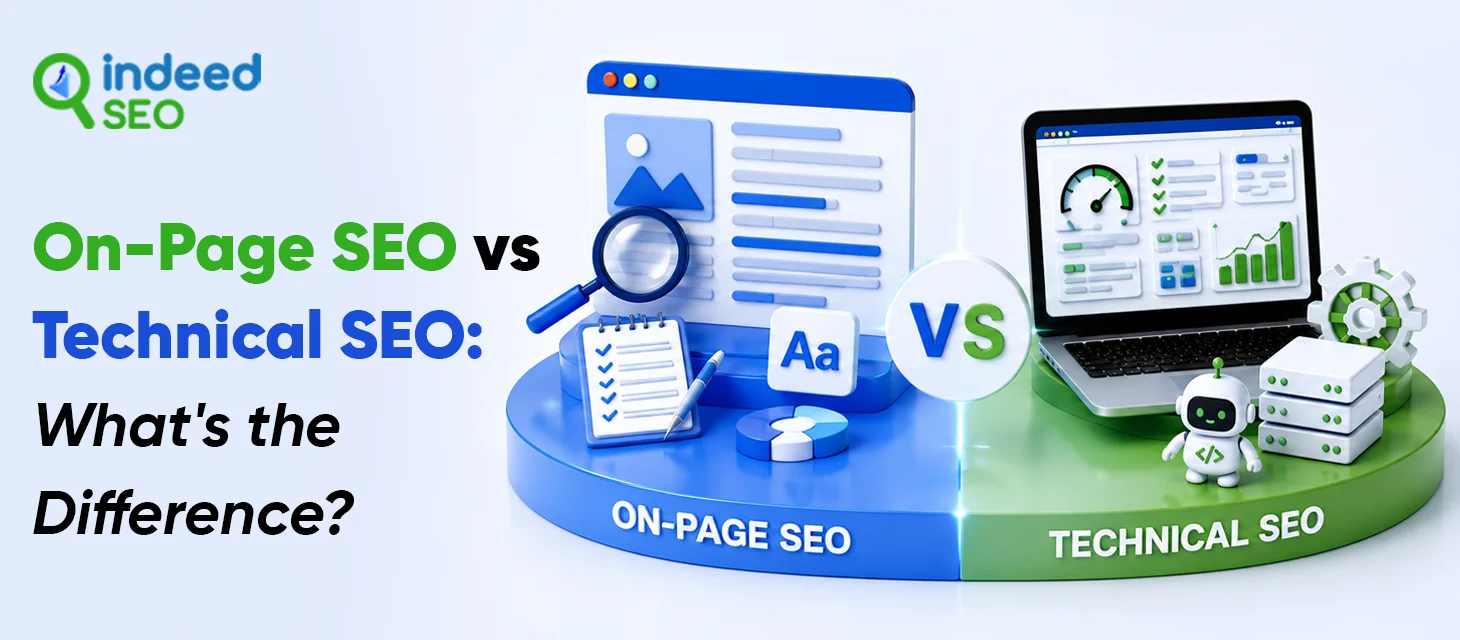
On-Page SEO vs Technical SEO: What’s the Difference?
| Factor | On-Page SEO | Technical SEO |
|---|---|---|
| Focus | Content and page elements | Website infrastructure |
| Goal | Improve relevance and user experience | Improve crawling and indexing |
| Keywords | Major focus | Limited focus |
| Content | Quality and search intent | Not the main focus |
| Site Speed | Secondary | Major focus |
| Crawlability | Limited | Major focus |
| Internal Links | Important | Supports site structure |
| Sitemaps | Not a core task | Important |
| Developer Support | Rarely needed | Sometimes needed |
Pros and Cons of On-Page SEO
On-page SEO is often the starting point because its changes are easier to understand and implement.
Pros of On-Page SEO
- A well-optimized page gives search engines a much clearer signal about what it’s actually about and which searches it deserves to show up for.
- Build around genuine search intent instead of stuffing keywords in, and you naturally pull in visitors who actually care about what you’re offering.
- Improves the experience for real people, too. Clear headings, a logical flow, useful information, links that actually help.
- Sometimes an old page simply needs better structure, updated information, stronger internal links, or a clearer focus.
Cons of On-Page SEO
- Search behavior shifts, competitors publish new content, information goes stale. Pages need updates.
- Trying to insert a keyword into every heading and paragraph can make content sound robotic. And readers notice.
- A beautifully optimized page won’t help much if search engines can’t crawl or index it properly.
Pros and Cons of Technical SEO
Technical SEO can feel less exciting because many of the improvements happen behind the scenes. But that doesn’t make them less important.
Pros of Technical SEO
- Fixing technical issues removes the barriers that may be stopping your pages from being crawled or understood properly.
- A faster, smoother site benefits everyone — visitors and search engines alike.
- A site can look completely normal on the surface while sitting on hundreds of broken links or indexing issues underneath.
- A 20-page small business site is one thing. A sprawling e-commerce catalog with thousands of URLs is a whole different thing.
Cons of Technical SEO
- Technical SEO can involve JavaScript, server settings, redirects, code, CMS configurations, and other areas where developer support may be needed.
- Diagnosing the problem can take a while. Sometimes you have to dig before you even know what’s wrong.
- A technically flawless website still needs pages worth ranking — ones that actually answer something.
On-Page SEO vs Technical SEO: Why Both Matter
On-page SEO and technical SEO are like two sides of the same coin, and you need both because a website needs to be readable by search engines and useful for users in order to rank well.
While technical SEO ensures that search engines can access, crawl, and index your site, on-page SEO signals to search engines that your content is high-quality and relevant to what users want to find. Without technical SEO, search engines may never get to see your amazing content. Without on-page SEO, search engines have less context to understand your website and determine where it belongs in search results.
Why Choose IndeedSEO for On-Page and Technical SEO Services?
With 14+ years of experience in the field and a team of 200+ SEO professionals, IndeedSEO helps companies with both on-page and technical SEO to improve search rankings, crawlability, and overall website performance through a data-driven approach.
- Successful Experience: Worked on 8,000+ global projects for multiple Industries.
- Professional Team: Get help from 200+ SEO experts for sophisticated marketing solutions.
- Top Industry Recognition: Recognized as a leading SEO agency by Semrush and Clutch
Turn SEO Insights Into Higher Search Rankings with IndeedSEO
The Bottom Line
Wondering whether on-page or technical SEO matters more? IndeedSEO takes a practical approach—because the answer depends on what your website actually needs. On-page SEO improves your content and relevance, while technical SEO makes sure search engines can properly access and understand your site. If technical issues are holding your website back, fix those first. If the content isn’t meeting search intent, focus there. And when both need work, tackle them together for stronger overall SEO performance.