+1 808 999 0096


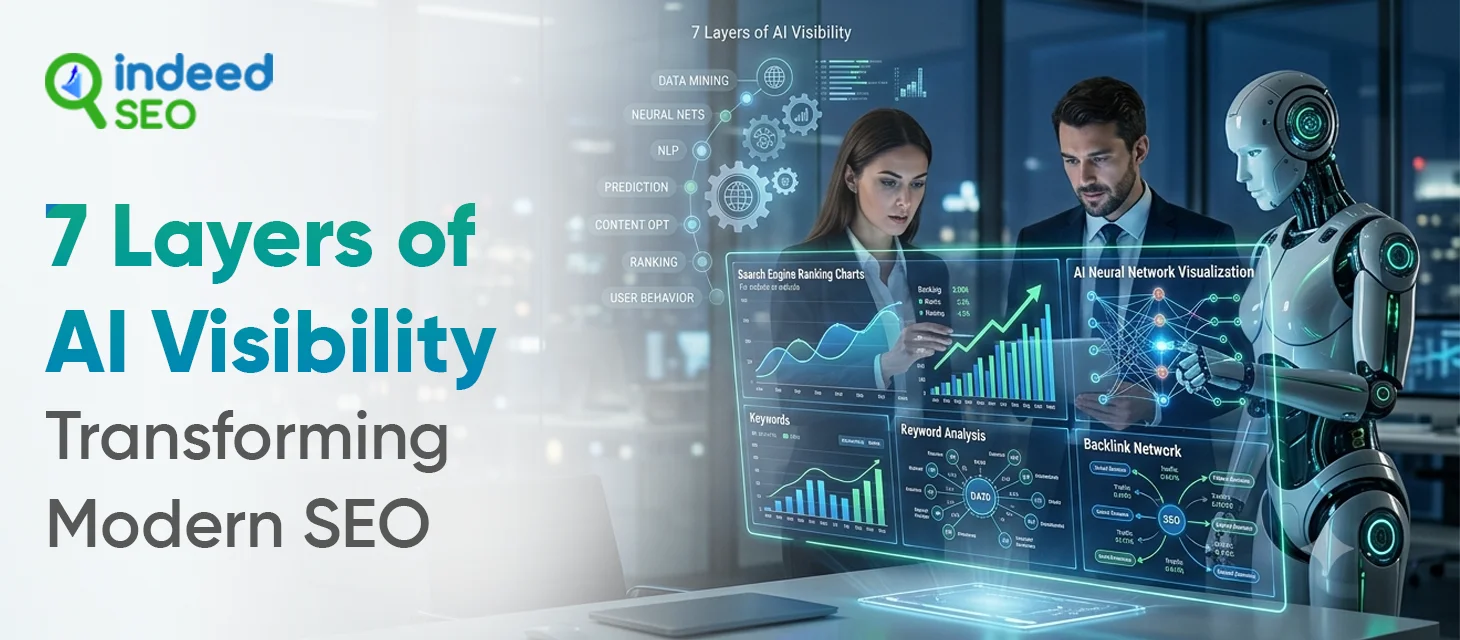
Modern search is no longer limited to ranking blue links on Google. The way people discover information is changing rapidly. Users are increasingly turning to AI assistants such as ChatGPT, Gemini, and Perplexity for immediate answers, advice, and information. In this new AI landscape, brands need to focus on becoming trusted sources that AI systems recognize, understand, and cite.
AI visibility is driven by multiple layers ranging from technical accessibility to Entity Recognition. Companies that optimize each layer can leverage AI-curated answers and gain relevance on conversational search platforms.
Improve your visibility across search engines and AI platforms with IndeedSEO!
1. Technical Accessibility
Before AI systems can understand or recommend your content, they must first be able to access and process it. A technically focused website is necessary so search engines and AI crawlers can find, crawl, and pull useful data from your pages.
Slow websites, blocked resources, poor JavaScript rendering, or weird website layouts also prevent AI systems from reading your content. Therefore, it makes sense to invest time in optimizing Core Web Vitals, boosting page speed, and ensuring that important content is in “easy to read” HTML rather than PDF.
A technically sound website is the cornerstone of AI visibility. Without Technical accessibility, even the best information could be hidden from a generative search system.
2. Machine Readability & Content Structure
AI models do not actually read the websites the same way we do. They analyze evolving patterns and extract important content that addresses all the queries you would have as a user, making content structure more important than ever.
Pages should be structured with clear headings, well-defined sections, short paragraphs, bullet points, comparison tables, FAQs, and direct answers to frequently asked questions. An AI-friendly content structure makes it easy for AI to crawl the content and extract relevant facts, which means your content is more likely to be sourced.
Businesses should not bury essential information within images, complex designs, or lengthy paragraphs, but instead make information available in plain, machine-readable formats that are comprehensible to both users and machines.
3. Structured Data & Schema Markup
Schema markup is like a language to help search engines and AI understand the meaning of your content. Human beings can recognize that a page is about a product or a company; machines require more signals to determine these relationships with higher confidence.
Use structured data such as Organization, Product, Article, Review, FAQ and Local Business schema markup to provide AI systems with straightforward, machine-readable information about your brand. For example, via schema, AI can process your company name, the services you offer, pricing information, product specifications, customer reviews and key business details. This minimizes misunderstandings and maximizes the likelihood that your content will be accurately cited in AI-generated responses.
4. Entity Recognition
Search has moved entirely beyond simple keyword matching. Modern AI understands “entities”—real-world people, brands, organizations, products, and concepts, alongside the web of relationships that connect them in a digital knowledge graph.
When a user searches for the “best healthcare app development company,” the AI does not just scan for those exact words. It queries its knowledge base to see which companies are established authorities in healthcare technology, what specific compliant services they offer, and how they relate to broader industry topics. To enhance entity recognition, companies must standardize core brand information across the website, social media channels, public directories, and trusted third-party publications. A cohesive digital footprint allows AI to map exactly where your expertise lies.
5. Topical Authority & E-E-A-T
AI systems prioritize content from sources that demonstrate deep Experience, Expertise, Authoritativeness, and Trustworthiness (E-E-A-T). Publishing fragmented, keyword-stuffed articles is an outdated strategy. Brands must build comprehensive knowledge ecosystems around the core pillars.
This requires creating interconnected content hubs: detailed guides, supporting technical articles, industry insights, and real-world case studies. For instance, a healthcare technology firm shouldn’t stop at a generic post about mobile apps. To prove topical authority to an LLM, they must publish exhaustive content covering healthcare compliance (HIPAA/GDPR), development costing structures, data security standards, and emerging patient-experience trends. Deep topical architecture signals to AI models that your website is a definitive destination for accurate data.
6. External Cites & Brand Authority
AI systems evaluate signals far beyond your own domain. Just as buyers trust recommendations from independent experts, AI models rely heavily on external validation and web-wide consensus when deciding which brands deserve the top citation slot.
Citations in industry publications, trusted review aggregators, premium podcasts, and digital PR campaigns strategies drastically elevate a brand’s algorithmic reputation. Beyond traditional hyperlinks, AI models look for “co-occurrence”—the frequency with which your brand name is mentioned in close proximity to industry keywords and recognized market leaders across the web. The stronger and more authoritative the third-party platforms validating your business, the more secure your footing in AI recommendations.
7. AI Visibility Measurement & Analytics
In the generative search era, keyword tracking is no longer sufficient. Enterprise businesses must actively measure “Share of Voice” within AI-generated answers and track whether AI models recognize them for high-value transactional prompts.
Modern AI visibility tracking focuses on key performance metrics:
- Brand mention frequency across conversational platforms (ChatGPT, Gemini, Claude)
- Direct citation and attribution rates in AI answers
- Share of Voice (SoV) comparisons against core market competitors
- Prompt visibility for specific user-intent queries
- Content indexing efficiency within generative search indexes
Utilizing advanced platforms like the Semrush AI Visibility Toolkit, Moz Pro, and dedicated GEO analytics frameworks helps businesses map, track, and optimize footprint across the modern conversational web.
Why Modern SEO Needs an AI Visibility Approach
The search landscape has fundamentally transformed. Users are no longer just browsing pages of search results; they are demanding immediate, synthesized answers from AI interfaces. Consequently, optimizing solely for traditional search rankings is no longer enough; brands must optimize for algorithmic recognition and systemic trust.
The Core Realities of AI Visibility:
- People are pulling direct answers from AI tools instead of clicking through multiple domains.
- AI platforms favor trusted sources with documented industry expertise and strong online reputations.
- Clear, helpful, and highly structured content is significantly easier for an LLM to accurately parse.
- External trust signals and co-citations directly dictate which brands get recommended.
Businesses must explicitly concentrate on becoming the definitive answer, rather than simply ranking for a keyword.
Future Trends in AI Visibility
AI search is scaling rapidly. Businesses that establish the framework today will hold a massive competitive advantage as digital discovery moves toward a deeply personalized, AI-powered landscape.
What’s Next:
- Brands will compete directly for the primary attribution slot in AI answers.
- Algorithmic trust will be built on original data, primary research, and first-hand experience.
- AI will categorize brands based on entity relationships rather than simple keyword densities.
- Unlinked brand mentions, reviews, and targeted digital PR will heavily sway AI confidence scores.
- Tracking will shift toward monitoring platform-specific visibility over legacy index rankings.
Improve your visibility across search engines and AI platforms with IndeedSEO!
Conclusion
Is your brand ready for AI search?
AI visibility isn’t built on a single, isolated SEO tactic. It is the cumulative combination of technical foundations, deeply helpful content, unambiguous entity signatures, and trusted external web signals.
At IndeedSEO, we help businesses prepare for the future of search by guiding them in building brands that are easier for AI systems to understand, trust, and recommend. The future of SEO is no longer simply about ranking higher—it’s about being the definitive answer that the AI shares.