+1 808 999 0096

 info@indeedseo.com

Generative Engine Optimization is a hot topic rising in digital industries. With a focus on smart content creation, GEO ensures your brand content is easily visible to search engines. It is a simple process of optimizing digital content with the help of AI, answer-first writing, and the E-E-A-T framework.
While it may sound technical, GEO is simple and highly useful for a business’s online performance. This blog will explain how GEO works, why it matters, and how its algorithms impact search results.
Improve your AI visibility today - get started with IndeedSEO!
What is Generative Engine Optimization?
Generative Engine Optimization is a method to improve how AI-driven content is ranked by generative platforms. It also takes into account the ease of content visibility and suggestion on LLMs to provide direct and brief answers. Considering traditional SEO mainly focuses on keywords and links, GEO focuses on content generated by AI engines worldwide.
Additionally, the GEO marketing service helps your content become visible on AI tools that generate quick answers for users. It works for all content forms that users might require. GEO optimizes your content to make it rank better when the AI engine generates users’ answers. It covers top generative engines like ChatGPT and Gemini.
How the Generative Search Engine (GEO) Works
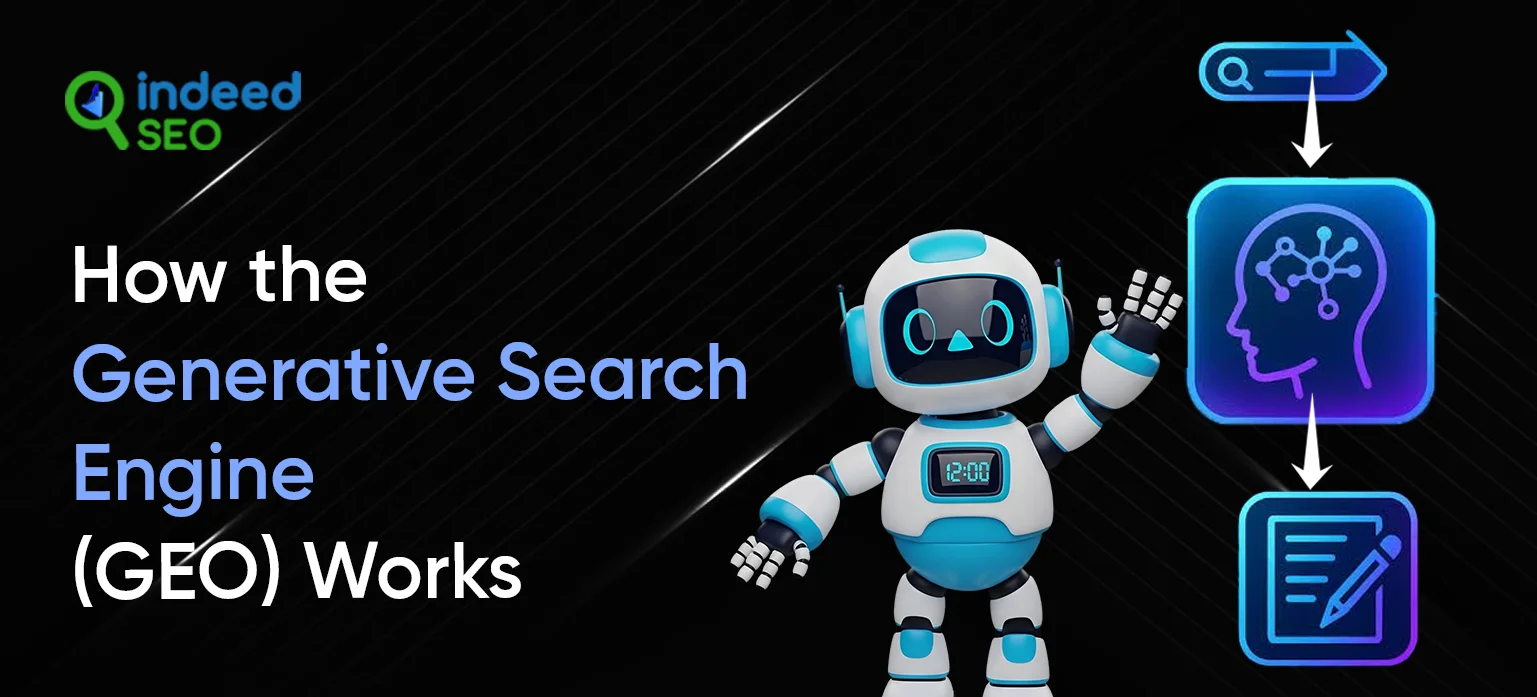
GEO works by applying structured strategies and algorithms to align with AI engines. GEO works in these major steps, covered below.
-
Content Understanding
AI engines read your content to understand its value. They use natural language processing to find out what your content talks about.
-
Context Matching
After understanding, the AI matches your content to users’ queries. It checks for brief and accurate answers as required by the user for the relevant result.
-
Ranking the Output
Finally, the AI decides which content to show first. This is based on the quality, relevance, and authority of the content. The better your content value, accuracy, and ease of reading, the higher it ranks.
Algorithm Insights Behind GEO
Generative engines use advanced algorithms. It combines machine learning, NLP, and large language models.
-
Semantic Analysis
AI reads your content to identify relevant keywords. Semantic analysis ensures AI picks the right meaning of your content.
-
Contextual Relevance
The algorithm checks if your content answers the user’s query. It also analyzes the user’s history to ensure vagueness is avoided in answers.
-
Content Freshness
AI prefers updated content. Algorithms ensure that it prioritizes the latest information to provide users with answers.
-
User Engagement Signals
Users’ engagement with the content matters. If people spend time on your content or click through links, the engine ranks it higher.
-
Authority & Credibility
Algorithms check if your content comes from a trusted source. Citing facts, using references, and having high-quality content boost credibility.
Key Differences Between GEO and Traditional SEO
Here are the key differences between SEO and GEO.
| Feature | Traditional SEO | Generative Engine Optimization (GEO) |
|---|---|---|
| Focus | Keywords, backlinks, website authority | AI comprehension and relevance to queries |
| Content Type | Long, structured articles | Text, images, and videos that AI can understand |
| User Interaction | Measured by clicks and visits | Considers AI interaction, like answers and summaries |
| Goal | Improve search engine ranking | Ensure visibility in AI-generated answers |
How to Optimize Content for Generative Engine Optimization
Optimizing content for GEO is similar to SEO but with an AI-focused approach.
-
Create AI-Friendly Content
Use clear headings, simple flow, and direct answers. Q&A style helps AI quickly grasp user intent.
-
Organize Information with Schema
Add structured data and metadata to highlight key information to read instantly.
-
Build Credibility and Trust
Boost credibility with reputable mentions and follow E-E-A-T principles: Experience, Expertise, Authoritativeness, and Trustworthiness.
-
Smart Keyword Use
When users ask questions, AI generates a clear and accurate answer using the most relevant keywords.
-
Evaluate Content Quality
AI checks the context and completeness. Factful and well-explained content ranks better.
-
Cite Sources
AI combines data from multiple reliable sources. Good sources may help your content become credible, giving your work visibility.
Benefits of Generative Engine Optimization
GEO offers several advantages for businesses and content creators:
Better AI Visibility: Your content is more likely to appear in AI-generated answers.
Higher User Engagement: Clear and relevant content leads to satisfied readers.
Future-Proofing: As AI platforms grow, GEO ensures your content remains discoverable.
Diversified Traffic: GEO can bring users from chatbots, voice assistants, and generative AI tools.

Conclusion
Generative Engine Optimization marketing (GEO) is an advancement in content discovery. With a focus on combining advanced content strategies and traditional SEO services, it benefits businesses in highly competitive markets. GEO is getting adopted by all major SEO companies for better ranking. With IndeedSEO, you can get your content geo-friendly to reach a wider audience faster. AI-driven searches are the future, and IndeedSEO offers you optimization that helps you stay competitive in the long run.