How to Generate Leads for Your Healthcare Business?

TABLE OF CONTENT

    Last Updated on January 9, 2026 by Gurpreet Kaur

    The single most critical element of success and growth in today’s healthcare business environment is generating leads. Whether for new patients or to gain trust for your practice, a hospital, or a clinic, you must attract new potential patients and build further on existing relations.

    In this guide, we will walk through basic steps and strategies on how to go about lead generation for your healthcare business.

    Importance of Lead Generation in Healthcare
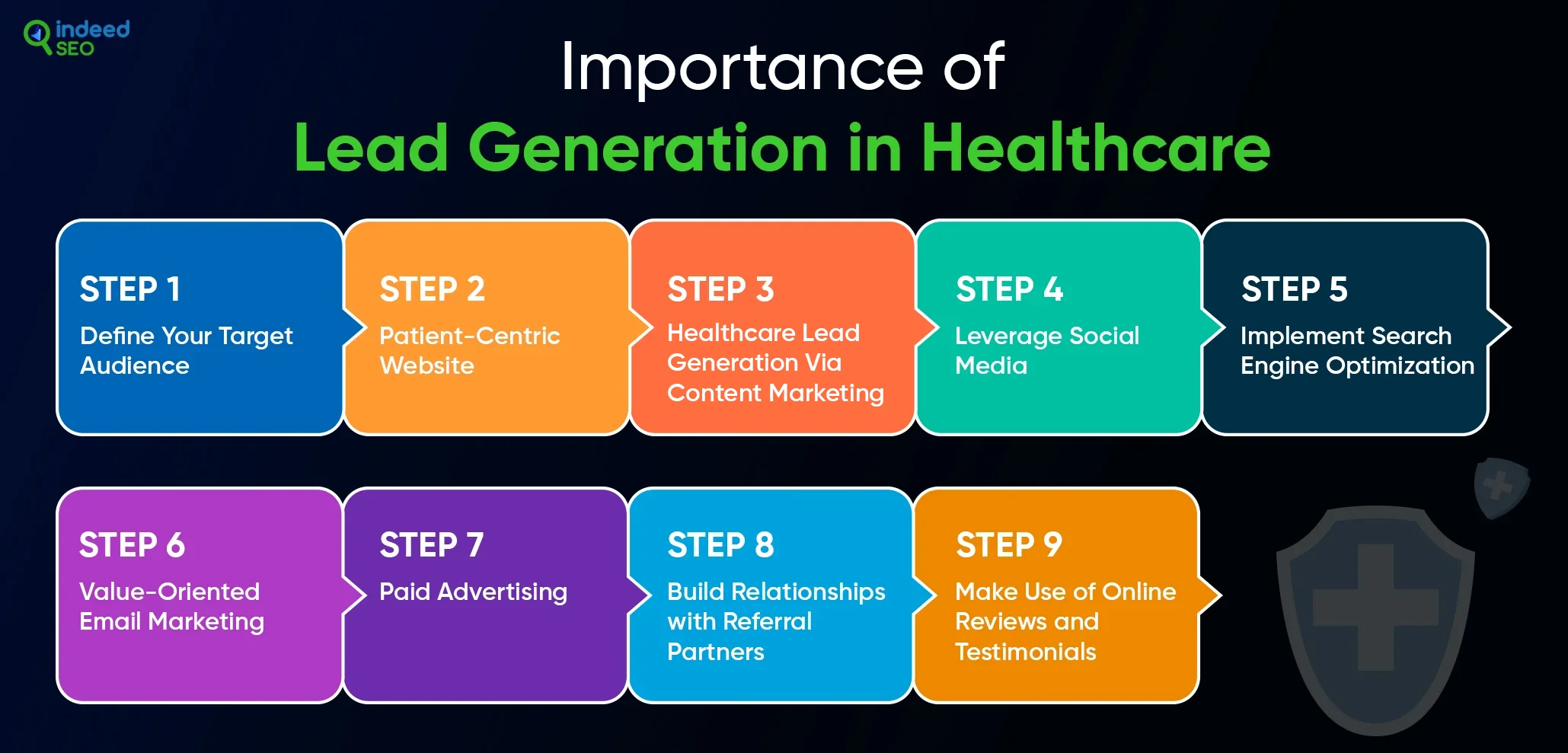
    Lead generation in healthcare is not so much a question of getting people attracted as it is a question of building trust and dependability. Basically, it is unlike other fields since it has to do with sensitive, mostly life-altering decisions. It, therefore, calls for an ethical, transparent, and patient-centric lead generation strategy. 

    The whole idea to generate high-quality healthcare leads is to build a pipeline of people likely to turn into prospects and finally patients. It starts with an understanding of the needs of the patient, going into creating value through content and service provision, nurturing such leads until they are ready to make a healthcare decision.

    Importance of Lead Generation in Healthcare

    Step 1: Define Your Target Audience

    You must know your target market well for lead generation. First, determine your ideal patient. Age, sex, and location are some of the demographics that can help you attract qualified leads through your marketing.

    Step 2: Patient-Centric Website

    Far more likely than not, your site will be the first contact with your practice for most leads. A clean, intuitive site is paramount to creating an explosion of good first impressions. 

    Make sure your site is mobile-friendly. Almost all your traffic will be landing on your site with a phone or a tablet. Content is clean and readable, easy to digest, and without any navigation headaches.

    healthcare - cta

    Step 3: Healthcare Lead Generation Via Content Marketing

    This is one of the most powerful lead-generation strategies in healthcare. You will create and share valuable information in your field to attract and engage prospects so they can then be converted into patients.

    Start with the kind of content strategy that provides information that answers the needs and interests of one’s target audience. This may come in the form of blog posts, articles, videos, infographics, and even eBooks. Here, the critical point is to give information answering common healthcare questions, offering solutions, and educating patients. 

    Step 4: Leverage Social Media

    Social media is a great platform to connect with potential patients to get leads. You can create a profile on popular platforms and promote your services by sharing relevant content. Make a customized social profile that reflects your values. Post regularly as one of your patient lead generation strategies.

    Step 5: Implement Search Engine Optimization

    Your strategy can’t skip search engine optimization if you are looking forward to generating leads effectively. You ought to increase the probability of finding your website on the first search engine results page by optimizing your website and content for the search engines, thus attracting organic traffic. 

    Start with keyword research. What are people searching for in healthcare SEO services? You must incorporate such identified keywords as part of your website content, meta descriptions, and even blog posts. 

    Besides on-page SEO, there is also off-page SEO that involves link building through authoritative sites that add to your authority and ranking.

    Step 6: Value-Oriented Email Marketing

    Begin building an email list—both prospect and patient. Do this through a form on your website, use a pop-up on your site, and share it on social media. Heck, you could even have an in-office form. Once you have that email list, segment it by age, health concerns, and other factors that you deem important, such as level of engagement.  

    Step 7: Paid Advertising

    There was certainly an organic side to our marketing efforts, but paid ads were really the ones that resulted in bringing us leads. You can place ads for your practice on a variety of platforms, including Google Ads and social media. It allows us to identify potential patients by demographic profile, interests, and even behavior.

    Ads on social media have comparable targeting options to allow you to find prospective patients on Facebook, Instagram, or LinkedIn. Ads may also be placed to advertise services, special offers, or events.

    Step 8: Build Relationships with Referral Partners

    Referrals are one of the most potent sources of leads in the health sector. The first step is to find those potential referral sources, such as primary doctors, specialists, or entities. One could approach them with a view to establishing a relationship based on mutually benefiting each other by way of referring patients to them or vice versa. It could also be in the form of conducting events, even educational outreach. 

    It can also involve referral marketing for satisfied patients. Encourage your current patients to refer their friends and families to your practice by discounting their treatment costs or offering other rewards in lieu of the referrals. 

    Step 9: Make Use of Online Reviews and Testimonials

    Consider the influence of reviews and testimonials on potential patients’ decisions. A satisfied patient comes across a positive review, they’re more likely to trust and feel safe with your practice.

    Encourage happy patients to write and post reviews and testimonials on-line such as Google, Yelp, and other healthcare industry-specific review sites. Email reminders, post-appointments, or put links to the writing and posting sites in your newsletters.

    Feature these reviews on your site and through your social channels. With positive reviews from other patients, the probability of conversion with respect to lead will increase.

    Revamp Your Branding and Logo

    Your branding and logo are some of the most important visible aspects of your business – how customers perceive your identity, values, and overall attitude. Refresh your brand to give it the look and feel of what your current goals and objectives are. A new unified logo may bring a stronger feeling to the destination target and stay longer in the mind. Whether updating or changing looks a refreshed identity sets you apart. 

    Craft Personalized Email Campaigns

    Customized email marketing can be an excellent way to engage and interact with your audience. Content personalization according to taste and behavior results in very relevant messages that connect to and engage with the recipient. A great email campaign is more than just informative. 

    Personalization allows users to gain value and turn them into loyal users. Use data to personalize subject lines and recommend relevant products at the appropriate point in the journey. Strong personalization increases open rates, clicks, and conversions, so email marketing is an important part of your marketing success overall.

    Conclusion

    Healthcare lead generation needs a layered approach. Keep in mind that lead generation is not an event. It’s a process, a continuously evolving journey. So much of your potential to grow your practice and be successful in the long haul depends on how well you listen to your patient base and to the industry in general.

    IndeedSEO can help your healthcare business fully implement such healthcare SEO strategies, which makes your lead generation campaign really effective and successful. Our experience in healthcare marketing can help you achieve your goal of increasing your patient circle.

    CTA

    FAQs

    Q1: What is healthcare lead generation?

    A: Healthcare lead generation attracts potential patients and builds trust before they choose your services.

    Q2: Why is lead generation important for healthcare businesses?

    A: It helps clinics and hospitals grow by consistently attracting new patients.

    Q3: Which marketing strategy works best for healthcare leads?

    A: Content marketing and SEO work best for building trust and long-term patient leads.

    Q4: How can reviews help generate healthcare leads?

    A: Positive reviews build credibility and encourage patients to choose your practice.

    Q5: Can SEO really increase patient inquiries?

    A: Yes, SEO improves online visibility and brings high-intent patients to your website.

    Do You Want More Leads and Traffic for Your Business?

    About author
    Gurpreet Kaur
    Gurpreet Kaur is a highly-skilled and exponentially experienced content writer at IndeedSEO. She has a passion for content writing and has written several quality blogs, articles, press reports, and more in several niches. Her expertise has helped several of our clients achieve their objectives and sustainable results in the long term.

    Ready to get started? Take your business to the next level with IndeedSEO

    Let’s Discuss Your Project
    discuss project